• About
  • Be Informed
  • Burness Case: Up-dates-scroll down
  • No Going Back
  • PETITION
  • The Destructiveness of Vanity

Fiji Pensioners

~ GREY POWER

Fiji Pensioners

Tag Archives: politics

Which Political Party Should The People of Fiji Vote For?

16 Friday Oct 2026

Posted by fijipensioners in Articles & Reports

≈ Leave a comment

Tags

economy, finance, history, news, politics

We all, each and every one of us, should be aware that since 1987, we have been governed by an assortment of the Almost Good, the Very Bad and the Disgustingly Ugly, plus corrupt, incompetent, greedy, and idiotic.

The time has come when we must for the future of the children and our Nation ensure that we vote and that we vote for a party that we truly believe is capable of working in the best interest of Fiji, its aged, its young, its poor, its future generations, which frankly rules out most government members we have had for the past 40 years.

This is a pragmatic assessment grounded in Fiji’s structural realities as a small, open, climate-vulnerable Pacific island economy with a history of political instability, ethnic diversity, high public debt, tourism dependence, and exposure to external shocks. These considerations could guide ANY FUTURE PARTY seeking durable national outcomes rather than short-term electoral advantage.

Political foundations

Long-term viability depends more on institutional quality than on any particular ideology:

  • Prioritise political stability and the rule of law. Fiji’s repeated coups and periods of tension have raised the cost of capital, deterred investment, and fragmented policy continuity. Strengthening independent institutions (judiciary, electoral bodies, anti-corruption mechanisms) and predictable constitutional rules reduces the risk of abrupt reversals that destroy credibility.
  • Build inclusive, multi-ethnic governance. Policies that systematically advantage or disadvantage one community over another recreate the zero-sum dynamics that have repeatedly destabilised the country. Broad-based legitimacy is more resilient than majoritarian or identity-based mobilisation.
  • Focus on competence and continuity over personality or patronage. High debt levels, climate risks, and the need for sustained investment reward parties that can maintain coherent multi-year strategies in infrastructure, education, and fiscal management rather than cyclical spending spikes before elections.
  • Maintain civilian supremacy and clear civil-military boundaries. Recurring military involvement in politics has been a source of uncertainty; durable democracy requires both professional security forces and civilian accountability.

These are enabling conditions. Without them, even well-designed economic policies tend to under-deliver.

Trade and economic orientation

Fiji’s size, remoteness, and vulnerability to cyclones and global commodity swings favour openness combined with deliberate capacity-building:

  • Deepen and diversify trade rather than retreat into protectionism. Tourism remains the dominant foreign-exchange earner, but concentration creates fragility. Expanding higher-value agriculture (including branded products), fisheries, niche manufacturing, and services while improving logistics, biosecurity, and quality standards increases resilience. Preferential access to Australia, New Zealand, and other markets is valuable only if domestic producers can meet standards and compete.
  • Engage regional and bilateral arrangements selectively and with clear safeguards. Agreements such as PACER Plus or others with major partners should be judged by whether they expand realistic market access, support infant-industry development where feasible, and avoid locking in rules that permanently constrain policy space. Fiji has historically approached some of these deals cautiously for exactly these reasons.
  • Balance major partners without exclusive alignment. Australia and New Zealand remain critical for tourism, labour mobility, and security; China, India, the United States, and others offer investment, infrastructure, and market opportunities. A non-aligned, interest-based approach that maximises options while preserving sovereignty is more sustainable than ideological dependence on any single external power.
  • Integrate climate resilience into trade and investment policy. Physical risks (cyclones, sea-level rise, droughts) already impose large costs. Policies that encourage climate-smart agriculture, resilient infrastructure, and insurance mechanisms protect both export capacity and fiscal sustainability. International climate finance can complement, but not replace, domestic reform.
  • Improve the investment climate through governance rather than solely through incentives. Rule of law, contract enforcement, transparent regulation, and reduced bureaucratic friction matter more for sustained foreign direct investment than temporary tax holidays. High public debt constrains fiscal giveaways; credibility is the scarcer resource.

Trade-offs and realism

Openness can expose domestic producers to competition and widen trade deficits if competitiveness does not improve. Protection can shelter jobs short-term but often raises costs for consumers and input-using industries. Fiscal expansion may be politically attractive yet risks debt sustainability given already elevated ratios. Climate adaptation requires upfront spending that competes with other priorities.

A future party’s most constructive contribution would be to treat these trade-offs explicitly, ground policy in evidence about what actually raises productivity and resilience in a small island setting, and build cross-community coalitions around shared material interests (jobs, security from disasters, rising living standards) rather than identity cleavage. Success will be measured less by ideological purity than by whether living standards, institutional trust, and shock-absorbing capacity rise over successive electoral cycles.

Wise words from Pramesh Sharma

12 Monday Oct 2026

Posted by fijipensioners in Articles & Reports

≈ Leave a comment

Tags

finance, history, investing, news, politics

The latest report that the FNPF pension dispute could potentially cost $700 million raises fundamental questions about justice, accountability, constitutional constraints and the responsibility of those entrusted with managing our national retirement savings.

First, the pensioners have been hard done by the previous Fiji First Government and the FNPF Board and Senior Management responsible for the 2012 pension reforms. These pensioners made their retirement decisions based on the terms and expectations that existed at the time.

For many, their pensions were not simply another financial product; they were the foundation of their retirement security, dignity and peace of mind. To reduce their pensions after they had committed their working lives and savings to the Fund has caused lasting hardship. Behind every financial estimate are elderly citizens, families and individuals who have lived with the consequences for years. The fact that a decision may have been defended on actuarial or financial grounds does not, by itself, settle the wider questions of fairness, legitimate expectations and accountability.

Second, the entrenchment of these provisions in the 2013 Constitution has created a serious obstacle to finding a just resolution. The present FNPF Board and Management must operate within the law as it stands. Even where there may be a genuine desire to address historical grievances, constitutional restrictions can severely limit their options. This is precisely why constitutional provisions affecting the pension dispute deserve careful scrutiny. A Constitution should uphold the rule of law, protect rights and provide access to justice. It should not become an unquestionable shield against examining whether past decisions were fair, lawful or consistent with the rights of those affected.

The current Board and Management should not be expected to act outside the law. Equally, they should not be left without a lawful avenue to address a longstanding injustice if a proper review establishes that redress is warranted.

Third, the application of Section 51 of the Constitution, whether rightly or wrongly interpreted in relation to this dispute, should be tested through appropriate judicial proceedings. No institution, Government or interested party should simply assume that its interpretation is beyond challenge.

A properly constituted judicial review, pursued by parties with the necessary legal standing, could examine the relevant legal provisions, their application and the extent to which the courts have jurisdiction to consider the issues raised. The courts would need to determine the precise legal questions, including the effect of any constitutional restrictions on their jurisdiction.

This is not about asking the courts to disregard the Constitution. It is about asking the courts to determine what the Constitution means, how its provisions interact and whether the legal barriers being relied upon have been correctly interpreted. The objective should be clarity, accountability and a lawful pathway forward.

Fourth, prudent governance requires the FNPF Board and Management to prepare responsibly for the possibility of future liability. If the Fund faces a credible historical claim, it would be poor governance to ignore that possibility simply because the present legal position appears restrictive. The Board should (or may have done already) commission independent legal advice, obtain an actuarial assessment and ensure that the potential financial exposure is properly evaluated and disclosed. Where appropriate, under the applicable accounting standards, a provision should be recognised if there is a present obligation, a probable outflow of resources and a sufficiently reliable estimate of the amount. If those recognition criteria are not met, the potential exposure should nevertheless be assessed for disclosure as a contingent liability where required.

This is not a call to pay an unproven claim prematurely, nor to use the retirement savings of current contributors indiscriminately to meet a historical obligation. It is a call for responsible financial planning, transparent risk management and a clear distinction between the Fund’s legal obligations and any responsibility that may properly rest with the State. The principle is simple; today’s legal obstacles should not be mistaken for a guarantee that tomorrow’s liability can never arise.

If a future constitutional review changes the relevant legal position or a competent court determines that a claim can lawfully proceed, the question of restitution could return with renewed force. The Fund and Government should not be caught unprepared.

The estimated $700 million figure reported in the Fiji Times must also be treated carefully. Any final assessment must distinguish between the amount claimed, the amount legally recoverable, the cost of any future pension adjustments and the party that may ultimately be responsible for payment. An estimate is not, by itself, proof of liability.

Ultimately, this matter is bigger than money. It concerns trust in our institutions, respect for retirement security and the principle that public decisions affecting people’s livelihoods must be capable of proper scrutiny.

The current Government, the FNPF Board and Management and the relevant legal authorities should work towards a transparent, lawful and financially sustainable resolution. If constitutional reform is necessary to remove an unjust barrier, that debate must be confronted honestly and through the proper constitutional process.

Our elderly pensioners deserve to have their grievances heard, their claims properly examined and their rights determined according to law. They should not be denied the prospect of justice merely because the passage of time has made the matter politically, legally or financially inconvenient.

Justice delayed is justice denied. But justice must also be pursued lawfully, transparently and with due regard for every FNPF member whose retirement savings must be protected.

Can we only expect 4 more years of the same?

10 Monday Aug 2026

Posted by fijipensioners in Articles & Reports

≈ Leave a comment

Tags

history, news, politics

Another excellent article from the pen of Charlie Charters:

AND SO IT STARTS …

The Prime Minister Sitiveni Rabuka readies us not for what he MAY deliver, but what he MAY NOT deliver in the next six months.

And his messaging is clear.

Get ready for the possibility of no Referendum on the wretched 2013 Constitution this side of the General Election.

That means at least one more General Election under the hated ‘who is my MP’ d’Hondt + Single Constituency system.

But that also means, get ready for the possibility of no referendum on the Great Council of Chiefs and the long tail of hot button, i-Taukei issues that have dominated submissions to the Constitutional Review Committee.

Why?

We may not have the money, Rabuka says, shrugging his shoulders, rather improbably playing the role of thrifty housekeeper after splashing upwards of $6m on the fiasco that is the Commission of Inquiry.

[The Fiji Revenue and Customs Service also messed up the PM’s ‘poor-me’ messaging last week by saying they had collected a record $3.51 billion in revenues – that’s $136m more than the $3.374b that has been factored in to all Government projections.]

This is how the table of options looks to me.

– The staging of the once-every-ten-years national census is a non-negotiable. The census has to happen on time or every aspect of managing the country is put out of whack.

– And the general election has to happen before February next year or the country falls off a constitutional precipice into a place we’ve never been before.

– So, axing the referendum, according to Rabuka’s not-so-subtle nudging, is may be the prudent thing to do. Fiji Government needs to live within its means etc.

And that is what Rabuka is openly suggesting in this Fiji One News report in a way I have not seen happen before.

In truth, as we see the shape of the next election, you could understand Rabuka’s thought process.

Unlike 2014, 2018 and 2022 this is not shaping up into a binary contest – one big name vs another.

It’s more like Rabuka vs a raindow of alternatives, principally his former Coalition partners and the FijiFirst/PeopleFirst offer.

And then some parties new and old, for whom crossing the five percent threshold could actively discourage voters for the fear of ‘wasting’ their vote.

So by any analysis, Rabuka stands to profit the most from the continuity offered by d’Hondt + Single Constituency.

Just like Bainimarama did until the Coalition’s one-MP-win in 2022.

The mirror image of that is true too.

Rabuka’s prospects in 2026/2027 make him the politician most disadvantaged by disbanding d’Hondt + Single Constituency in favour of a return to the multi-constituency structure and either first-past-the-post or any other form of proportional representation.

Rabuka is the last ‘Big Man’ standing in this wretched single constituency d’Hondt system that Aiyaz Sayed-Khaiyum and advisors so obviously selected for Bainimarama for that very same reason.

Rabuka’s calculation would be that with his brand recognition and The People’s Alliance‘s rather tragic retreat towards appealing to an i-Taukei audience and no-one else, he can get enough personal votes to pull through a larger number of MPs than anyone else.

If the CRC determine to break away from Single Constituency and put that option to a national referendum, the quality of candidate MPs becomes of much greater significance, not just that they are attached to the tailcoats of a Big Man.

My old ‘constituency’ of Vuda, however that’s marked out under a potential return to multi-constituences, would give me maybe a half-dozen potential MPs to consider.

All the voters would get to give them a hard looking-at because the number of candidates is bite-size and manageable.

You can’t hope to do that with the ridiculous 342 candidates you had to wade through in 2022, all asking for your vote under the Single Constituency model.

The big question from the Rabuka nudge – get ready to give up something I promised you – is:

a) is this a trial balloon? Just Rabuka floating an idea, as he does regularly, and then walks it back – civil service job losses, no civil service job losses etc.

b) or is this a way of triangulating public opinion so that, with the excuse of prudent financial housekeeping, he gets us ready to nod along when Rabuka boots the CRC’s proposed Constitution into the long grass of the next Parliament of the Republic of Fiji?

and c) how will ‘Sorry but no referendum’ play with his increasingly narrow i-Taukei voter base, which is shrinking back to having a definite older, more traditional and rural vibe?

Will it break through that no referendum means delaying for at least another two to three years a vote on re-establishing the GCC within the constitution, and all that that might mean?

Will that prove one broken or fudged promise too many or will the avalanche of returned titles and other i-Taukei goodies prove to be enough sugar to make this bitterest of pills go down?

#Fiji#FijiPolitics#FijiPol#FijiGovernment#elections

Niko Nawaikula

See less

A list of wrongdoings from the honest pen of Charlie Charters.

10 Monday Aug 2026

Posted by fijipensioners in Articles & Reports

≈ Leave a comment

Tags

music, news, poetry, politics, writing

AND SO … it comes to pass.

Today in Justice Dane Tuiqereqere’s High Court No.13 we will understand the fate of the Commission of Inquiry – one of the most extraordinary legal and political chapters in Fiji’s history.

There are three separate parties who petitioned for the judicial reviews of the COI Report after they were ‘adversely named’ in it: Barbara Malimali; Graham Leung; and Wylie Clarke and Laurel Vaurasi.

Malimali and Leung lost their jobs directly as a consequence of the COI Report.

All three sets of petitioners, as well as the State, acting on behalf of the COI, have the right to appeal whatever is Tuiqereqere’s decision.

To paraphrase another writer: this may not be the end but it may be the beginning of the end.

I would not want to predict Tuiqereqere’s decision.

But on this significant date – just to contribute one final piece of the jigsaw.

Attached below is a copy of the police report I made on the subject of David Ashton-Lewis.

It was dated August 11 – almost exactly one year ago today – which seems like serendipity.

I had never filed a police report before. But I was requested to by the Chief Registrar, writing on behalf of the Judicial Services Commission, after I brought to the JSC’s attention Ashton-Lewis’s dodgy CV.

Only 18 months previously, the JSC had approved the appointment of David Ashton-Lewis to the Fiji Supreme Court even though Ashton-Lewis’ last judicial service ‘on the bench’ was 1995 – 28 years earlier.

Ashton-Lewis’s career after he left Fiji in 1995, a year before his term concluded, was almost 20 years in corporate law.

This included Ashton-Lewis’s employment as general counsel to Professional Investment Services [PIS] who sunk millions in client money into a number of failed investments including the infamous Westpoint collapse.

This and other similar schemes relied on complex and controversial ‘mezzanine’ financing, the cash for which was provided by high-pressure sales teams [supposedly supervised and regulated by Ashton-Lewis and his officers] who were often found to be taking commission both from customers and developers.

All that was missing from the CV that Ashton-Lewis sent to the JSC – no reference whatsoever to Professional Investment Services for instance.

And no reference to the long-running legal fights that PIS and its ownership had with the Australian financial regulator, ASIC, and ASIC’s adverse findings.

What Ashton-Lewis did reveal in the judicial CV sent to the JSC contained at least three major falsehoods:

– that he was entitled to use the letters ‘SC’ after his name indicating he was raised to the status of a silk, as Senior Counsel

– that at the time he was applying for the Supreme Court, he was an adjunct law professor and

– that he had been honoured by the late Queen for services to the law

On August 11 my police complaint was emailed to CID.

Victor Lal of Fijileaks made a similar police complaint to CID on September 7 and a supplementary complaint on September 13.

Lal’s focus was more on exposing the lie that Ashton-Lewis had ever been honoured by the late Queen [whose name he spelt Elisabeth in his CV – a sure tell of a wrong’un].

Ultimately, the police submitted mine and Victor’s files to the ODPP and any other research they had done, and the ODPP decided in January this year not to prosecute Ashton-Lewis.

That he was claiming honours and titles that were plainly false remains true. I called him a conman. Alex VB complained to FICAC because calling him a conman was mean; even FICAC didn’t think it was worth investigating.

The ODPP’s decision is their prerogative and I have no issue with that.

Despite his CV [and whatever we discover from Tuiqereqere’s judgement today], Ashton-Lewis is still a Fiji Supreme Court judge.

It’s an honour he clearly luxuriates in – see The Judge on 4CRB – but he has not been assigned any Supreme Court cases, not one, since his peculiar elevation to Fiji’s apex court.

The JSC has made no move [that I am aware of] to put him in front of a tribunal of his judicial peers to investigate his CV.

That’s the JSC’s responsibility: to make peace with history, their consciences and the precedent that this conman’s accession to the pinnacle of Fiji law sets for all time.

My conscience is clear. I did what I felt was my duty as a citizen to do by filing the police report.

My thinking was there was no point clanging away like an empty vessel on the social-media sidelines and refusing to help when the police come to you for assistance.

What Prime Minister Sitiveni Rabuka would have been hoping for from his pal Ashton-Lewis, in exchange literally for the millions he handed over to him and Janet Mason [who Ashton-Lewis insisted was a ‘KC’ when she never was], was a Commission that was at the very least a reliable and fair custodian of the legal process.

Maybe, Rabuka might be willing to accept, the COI Report reached conclusions that were a bit of a reach.

But at least, the PM would have expected, his pal Ashton-Lewis could be trusted to run the COI on a legally sound and fair, and professional basis.

That’s the crux of what Tuiqereqere is being asked to rule on today: was the whole thing fair to those adversely named?

Ashton-Lewis looked like he was a judge from central casting: his waistcoat, fob watch and old-world affectations.

But he was a woefully out of touch and hadn’t been a judge running a court room, let alone a Commission of Inquiry, since the year before John Howard became Australian PM

It always struck me as unlikely that Ashton-Lewis managed to do something with the COI – keep everything straight, fair and legal – that he couldn’t even manage with his own CV.

Anyway, the police report is interesting.

It explains how it was all thanks to Vilisi Nadaku uploading Amani Bale’s video testimony which I watched one early morning while staying with my mother.

I was hopelessly jet-lagged and looking for something to send me back to sleep.

But Amani Bale’s testimony – and Ashton-Lewis’ appalling rudeness to him – set in motion something of a personal mission.

I began to ask questions about a judicial figure who has caused Prime Minister Sitiveni Rabuka one High Court catastrophe after another, and sucked the air of the Fiji Government’s tires.

Fiji Constitution Review Commission

04 Thursday Jun 2026

Posted by fijipensioners in Articles & Reports

≈ Leave a comment

Tags

democracy, history, news, politics

I submit this as a concerned citizen and pensioner regarding the profound injustice inflicted on thousands of FNPF members, particularly the oldest and most vulnerable pensioners, through the Fiji National Provident Fund reforms introduced in 2012 (via the FNPF Decree 2011) and subsequently shielded and purportedly legalized by provisions in the 2013 Constitution.

The 2012 changes drastically reduced pension conversion rates (e.g., from around 15% to 8% in some descriptions) for existing or transitioning pensioners. This altered long-standing contractual expectations based on contributions made over decades under prior rules.

An Act or constitutional mechanism under the 2013 Constitution then backdated or entrenched these changes, effectively validating actions that many viewed as unlawful at the time.

This was morally indefensible and legally flawed in both principle and application. I urge the Commission to recommend amendments that uphold the rule of law, protect acquired property and contractual rights, and prohibit such retrospective deprivations.

Legal Wrongs in Principle and Application

  1. Violation of Acquired Rights and Contractual Expectations:
    FNPF contributions were made under a defined scheme with promised pension benefits. Altering these mid-stream for those already retired or near retirement breached the fundamental principle that pension rights, once vested, constitute property rights protected under basic rule of law norms. Retrospective legislation that deprives individuals of benefits they had reasonably relied upon undermines legal certainty (nullum crimen, nulla poena sine lege extended to civil/property contexts) and the prohibition on ex post facto laws that harm individuals.

The 2013 Constitution’s provisions that entrench or backdate the 2012 changes prioritize state/fund “sustainability” over individual rights. This inverts the proper hierarchy: the Constitution should protect citizens from arbitrary state interference in vested rights, not shield past illegal or unfair executive decrees.

  1. Retrospective Legalization of Questionable Actions:
    If the 2012 Decree was challenged or perceived as illegal (due to lack of proper process, unfairness, or exceeding powers under the then-prevailing framework), using the 2013 Constitution to immunize it retroactively sets a dangerous precedent.
  2. Constitutions should not be tools for validating past wrongs but for establishing enduring protections. Backdating validation deprives affected parties of remedies they might have pursued and erodes public trust in institutions.

This contravenes international best practices and common law principles against retrospective laws that divest property or accrued benefits without fair compensation or justification.

  1. Discriminatory Impact on the Oldest Members:
    The reforms disproportionately harmed older pensioners who had contributed under the old rates, had limited working years left to adjust, and could not benefit from any “sustainability” gains for future generations. This age-based impact raises equality and non-discrimination concerns. Protecting the fund’s long-term health is a valid policy goal, but it should not come at the expense of those least able to bear the burden without transitional justice measures (e.g., phased adjustments, government top-ups funded by general revenue, or exemptions for pre-reform retirees).

Moral Wrongs

  • Breach of Trust and Social Contract: Citizens contributed to FNPF in good faith, expecting the state/Fund to honor the terms. Breaking this for the elderly—who often have fixed incomes, health issues, and no recourse— is a profound moral failure. It treats pensioners as adjustable variables in actuarial models rather than people with legitimate expectations and dignity.
  • Intergenerational Injustice Misapplied: While cross-subsidization from young to old can be unsustainable, abruptly shifting the entire burden onto those already retired is inequitable. True fairness requires balancing sustainability with honoring past promises, perhaps through broader fiscal support rather than raiding individual savings pots.
  • Undermining Social Cohesion: Such actions foster cynicism toward government and institutions, especially when combined with perceptions of the 2013 Constitution’s legitimacy and amendment difficulties. Affected pensioners and families feel betrayed, leading to ongoing calls for reinstatement that the current framework blocks.

Recent government statements acknowledge the human impact but cite the Constitution and a $582 million backdating cost as barriers. This highlights the problem: the Constitution itself obstructs remedies for an acknowledged injustice.

Recommended Constitutional Amendments:

To prevent recurrence and provide justice, I recommend the Commission propose:

  • Explicit protection for vested pension and retirement benefits as property rights, immune from retrospective diminution without compelling justification and fair compensation.
  • Stronger prohibitions on retrospective laws that adversely affect accrued rights.
  • Provisions requiring transitional fairness in any fund reforms (e.g., grandfathering clauses for existing pensioners).
  • Mechanisms for independent oversight of FNPF governance and reforms to ensure member interests are prioritized.
  • Easier, people-driven amendment processes so future generations can correct entrenched injustices without undue barriers.

These changes would align the Constitution with principles of justice, human rights, and good governance.

Conclusion:

The backdating or entrenchment via the 2013 Constitution of the 2012 FNPF changes was legally wrong because it violated rule of law fundamentals, property rights, and non-retrospectivity.

It was morally wrong because it deprived vulnerable elderly citizens of contracted security after a lifetime of contributions.

The Constitution must be amended to remedy this specific injustice (where feasible) and safeguard against similar future actions.

Failure to do so perpetuates harm and erodes the Constitution’s moral authority.

I urge the Commission to consider the voices of affected pensioners during nationwide consultations and recommend changes that restore faith in Fiji’s constitutional framework.

Thank you for considering this submission.

R T. Rickman Vuda Fiji. 04 June 2026

GROSS INJUSTICE IN FIJI

15 Friday May 2026

Posted by fijipensioners in Articles & Reports

≈ Leave a comment

Tags

economics, finance, news, personal-finance, politics

Pramesh Sharma

The injustice faced by Fiji’s FNPF pensioners since 2012 remains one of the darkest unresolved financial and moral issues in our nation’s history.

In 2012, the FijiFirst Government, through an unelected and controversially appointed FNPF Board, drastically changed the pension scheme for a specific group of retired pensioners who had legally opted for the 25% life pension arrangement offered by the Fund at the time of their retirement.

These pensioners did not force the scheme upon FNPF. They entered into a lawful agreement with the Fund. The Fund itself promoted and guaranteed these pension arrangements. Members made retirement decisions based on those promises. Many surrendered lump sums and committed their life savings to FNPF because they were assured of guaranteed pension payments for life.

Today, some try to justify the pension cuts by arguing that retirees had already received “more than what they contributed.” That argument is fundamentally flawed, illogical and rather irresponsible!

This was never meant to be an ordinary savings withdrawal account. It was a LIFE ANNUITY arrangement, a pooled pension system based on risk sharing. If a pensioner died shortly after retirement, the remaining balance stayed with the Fund. The member’s family did not continue receiving those payments. In those cases, it was the Fund that benefited.

The understanding was simple; some members would die early, others would live longer and the Fund accepted that actuarial risk in exchange for holding and investing pensioners money. That is how pension systems around the world operate.

What makes this issue even more painful is that these early retirees were among the very people who helped build FNPF into the financial giant it is today. They kept faith in the Fund during its formative years. Their money was invested over decades into the very assets and developments that helped grow FNPF into a fund now reportedly worth over $12 billion. Yet the same pensioners were later told they were suddenly a “burden” on the Fund.

The justification used in 2012 was “actuarial sustainability.” The Board argued that continuing to pay the agreed pension rates would threaten the future stability of FNPF. But this raises a very important questions, in a country where FNPF membership is compulsory and regulated by the State, should the Government not ultimately stand behind the sustainability of the national provident fund?

Around the world, governments routinely support or guarantee national pension systems because retirement security is not merely a commercial investment issue; it is a social obligation.

Instead, Fiji chose to reduce the pensions of elderly retirees AFTER they had already retired and AFTER contracts had already been entered into. Even more disturbing is that while pensioners endured reduced incomes for more than a decade, FNPF in recent years has declared annual interest rates of 8% to 9% to existing members and now reports record financial strength.

This naturally leaves many asking, if the Fund is financially healthy today, why were pensioners made to suffer for so long without full justice or restoration?

Another major concern is the constitutional protection surrounding the 2012 reforms. The decrees and amendments introduced during that period were later entrenched under the 2013 Constitution, making legal challenges extremely difficult. Many pensioners believe they were denied proper access to judicial review and constitutional remedy. The current Board and Management can do nothing as it is now LAW imposed by one man!

This is why the issue refuses to disappear.

This is not just about money, it is about trust, it is about contractual fairness and it is about dignity. Most importantly it is about how a nation treats its elderly citizens after they have spent their lives contributing to the country.

Every year, more affected pensioners pass away without seeing justice. Many die believing they were betrayed by both the Fund and the State. The Fiji Government through Hon Prime Minister Sitiveni Rabuka must address this matter with compassion in finally addressing this issue properly. A humane and honourable resolution is long overdue.

A country cannot build a just future while ignoring the unresolved pain of its elderly citizens. ⚖️

Pramesh Sharma

The 1987 Culprit still holds the reins of abused power and corruption!

14 Thursday May 2026

Posted by fijipensioners in Articles & Reports

≈ Leave a comment

Tags

democracy, history, news, politics

The man who started it all in 1987 is still Prime Minister of Fiji today.

By Eremasi Matanatabu

On May 14, 1987 — 39 years ago today — Sitiveni Rabuka walked into Fiji’s Parliament with armed soldiers and overthrew a democratically elected government. He granted himself immunity, became Prime Minister in 1992, and is Prime Minister again now.

In that time: 4 coups. 70,000+ people fled. Poverty tripled. HIV is now the fastest growing epidemic in the world. Children as young as 6 are rape victims. Meth floods our streets. And the man who opened that door has never faced a single day of accountability for what he started.

What research says: how moral decay works in societies:

Stage 1 — The signal event

Research on societal collapse (Blanton et al., 2020, studying 30 pre-modern societies) found that moral decay begins with a single decisive act by a leader that breaks the social contract. The message sent to an entire society is: rules do not apply equally to everyone.

Fiji: May 14, 1987 — Rabuka enters Parliament with armed soldiers.

Stage 2 — Impunity is formalised

When the perpetrator not only escapes punishment but is rewarded — with power, promotion, and legal immunity — the signal is amplified. Research calls this the “impunity cascade”: if the most powerful break the law and face no consequence, why would anyone else feel bound by rules?

Fiji: Rabuka promoted, granted amnesty, becomes PM 1992.

Stage 3 — Institutions hollow out

The judiciary, police, and civil service lose independence when they see that power — not law — determines outcomes. Research shows this leads to selective enforcement, corruption, and a public that stops trusting institutions entirely. People stop reporting crimes. Courts become tools of whoever holds power.

Fiji: 4 coups, judiciary placed on leave (2007), police commanders loyal to coup leaders

Stage 4 — Social norms collapse

Once formal institutions fail, informal social norms — community accountability, family structures, cultural expectations — come under enormous pressure. Research (ResearchGate, 2022) identifies “economic pressure, weak governance, corruption, cultural erosion and family breakdown” as compounding drivers once this stage is reached.

Fiji: Begging, street children, drug use in schools, rape victims are children

The Fiji impunity chain — each coup rewarded, not punished

1987 ×2

Coup 1 & 2

Lt. Col. Sitiveni Rabuka

Overthrows the elected Bavadra government twice. Declares himself Head of State. Economy contracts. 70,000+ people flee.

Governor-General grants amnesty. Rabuka promoted to Commander of RFMF. Returns as elected PM in 1992. Serves until 1999. Returns as PM again in 2022 — and leads today.

2000

Coup 3

George Speight (civilian nationalist)

Takes Parliament and PM Chaudhry hostage for 56 days. Tourism collapses 30%. Economy contracts 8.2%. Soldiers tortured and killed.

Military signs Muanikau Accord granting Speight amnesty in exchange for releasing hostages. Speight later sentenced to life — but in September 2024, pardoned by the Mercy Commission. Rabuka reportedly orchestrated the pardon and planned a personal meeting with Speight as a “friend.”

2006

Coup 4

Commodore Frank Bainimarama

Overthrows elected PM Qarase. Suspends constitution. Places Chief Justice on leave. Media censored. Dissidents arrested. Rules by decree for 8 years.

Issues the “Immunity (Fiji Military Government Intervention) Promulgation 2007” — full, unconditional immunity for all coup participants. In 2010, the Limitation of Liability for Prescribed Political Events Act grants irrevocable, absolute immunity. The 2013 Constitution bakes this in permanently. Bainimarama becomes elected PM in 2014, rules until 2022.

What researchers and Fiji’s own commentators say about this pattern:

“It is no secret that the 1987 coup let the proverbial genie out of the bottle, which continues to rage through the political landscape in Fiji. It altered the role of the military, the executive branch of the government, the civil service and party politics to what we have today.”

— Fiji Times opinion, March 2024

“The only coup leader to have actually suffered as a result of their actions is George Speight — and he was not a soldier. Both Bainimarama and Rabuka were senior military leaders, and they were clever and powerful enough after their coups to ensure that Fiji’s constitution was rewritten to absolve them of any legal wrongdoing.”

— Devpolicy Blog, Australian National University, September 2022

“Amnesty, as a symbol of freedom, was more and more seen as a kind of ‘insurance on impunity’ with the emergence, then proliferation, of self-amnesty laws proclaimed by declining military dictatorships.”

— UN Special Rapporteur Louis Joinet, cited in international law research

“Corruption, selective law enforcement and impunity erode belief that rules apply equally, reducing citizens’ intrinsic motivation to follow norms.”

— Converging research from sociology, political science and behavioural economics

The cascade: how impunity at the top becomes moral decay at every level

Coup leader declares immunity for himself → The message to every Fijian: power protects you from consequences

Military and police become politicised → Law enforcement serves power, not justice. Crimes go unpunished if the right people are involved

Skilled professionals and community leaders emigrate → 61% of skilled workforce leaves. Moral anchors of communities disappear.

Families fragment

Poverty deepens, youth unemployment hits 60% → Young people without hope, family stability or role models become vulnerable to drugs, gangs and crime

Drug trafficking networks fill the vacuum → Organised crime exploits weak institutions. Meth becomes the economy for those with no other options

HIV, sexual violence, street children, begging → The visible face of what 40 years of impunity produces at street level

Churches multiply but moral authority fragments → More denominations, less unity, less community accountability. Each group retreats into its own walls

The coup leader who started it all is back in power → The cycle is complete. Impunity is not just tolerated — it is rewarded, permanently, at the highest level

Will Rabuka destroy Fiji’s future with his latest transaction?>

13 Wednesday May 2026

Posted by fijipensioners in Articles & Reports

≈ Leave a comment

Tags

environment, fiji, news, politics, travel

FIJI IS OUR BRAND, WHAT DO WE LOSE IF WE TRADE IT FOR INFRASTRUCTURE DECISIONS OUR CHILDREN AND LANDOWNERS WILL HAVE TO LIVE WITH?

Dobs Tukana

Will we protect what makes Fiji special before we accidentally or deliberately trade it away?

What I’m sharing will affect all of us even before the first concrete is poured.

It all starts with one decision.

One moment that can shape Fiji for the next 30 to 50 years.

We have every chance to build something truly global from what we already have.

But we also risk slowly “shooting ourselves in the foot” if we get this wrong….

And it all begins with Vuda……..

Please like read & share Post 3B……

POST 3B INTRODUCTION

This post will reveal something much bigger than a single infrastructure project.

Because what is now unfolding is no longer just an engineering discussion.

It is becoming a national question about legacy, accountability, economic survival, and the long-term direction of Fiji itself.

And the reality is this:

All of this may begin with one decision (WtE Vuda)

One approval.

One signature.

One Environmental Impact Assessment process.

One moment where Fiji decides what kind of future it is willing to lock itself into.

And in infrastructure systems thinking, this is exactly how national trajectories begin to change.

Because long after governments, consultants, developers, and decision-makers move on…

it is ordinary Fijians, landowners, future generations, local businesses, and the national economy that will ultimately live with the consequences of these decisions.

And this is where the conversation becomes uncomfortable.

But something about this issue has continued sitting heavily in my heart…

And honestly, I believe God is speaking to me very clearly about it.

Not to attack development.

Not to attack government.

Not to attack investors.

But to shed light on the long-term consequences that can happen when development decisions are made without fully understanding what may unfold 20,30, or even 50 years later.

Most people may not have seen this angle before….

This is the lens of someone who has lived inside both worlds, Fiji’s lived reality and global Tier 1 development systems.

You only truly understand this when you sit inside environments where infrastructure is not just engineering, but national economic strategy.

Because Fiji has already experienced moments like this before…

The Monasavu land issue is one example that stayed with me deeply growing up.

My own family (maternal link) comes from the Monasavu landowning units (Yavusa o Nubu) connected to the Hydro Scheme.

Back in the 1970s, many of our elders, uncles, cousins and grandfathers did not have the technical exposure, legal understanding, or global development experience to fully understand the long-term implications of those negotiations and agreements.

They trusted the process.

They trusted leadership.

They trusted development.

But decades later, compensation issues still affected families.

I still remember the emotional moment in our home when payments were finally resolved properly around 2005.

The happiness in the room.

The relief.

The emotion.

That moment stayed with me for life.

Because I realised something very important:

Development decisions do not end when construction finishes.

Sometimes the real consequences only appear decades later.

And by then, the original decision-makers are often gone.

The people left carrying the burden are usually:

• the landowners

• the younger generations

• the ordinary families

• and the communities connected to the land itself

MY LIVED EXPERIENCE, WHY THIS LENS EXISTS

That young boy growing up in Lautoka in the 1980s is no longer the same person today.

Before I ever entered global environments, development was already part of my life.

My father worked in the Monasavu Hydro Scheme in the 70’s and later joined what became the Fiji Electricity Authority and now EFL.

My uncles & cousins were carpenters and foremen.

One of my Tatalevu was the General foreman during the Lautoka Hospital construction back in the days.

Construction, infrastructure, and development were not concepts to me they were family life conversations.

That is how I grew up understanding Fiji.

Later in life, I joined the British Army-Royal Engineers.

Even there, instructors would often say something I never forgot (& my fellow serving and veterans will attest to this):

“Why would you leave Fiji when people from all over the world pay to experience where you already come from?”

At that time, I did not fully understand what they meant.

Years later, I understood.

God later blessed me with opportunities to work inside some of the world’s most advanced development environments:

• Riyadh

• Dubai

• Abu Dhabi

• London

And what many people may not realise is this:

You only begin seeing development differently once you are actually sitting inside Tier 1 systems helping shape economic growth every single day.

Not just watching projects from the outside.

Actually, sitting at the table.

Watching how governments and developers decide:

• where infrastructure should go

• what economic value it unlocks

• what risks it creates

• how tourism is protected

• how investor confidence is maintained

• and how national branding is strategically defended

From:

• data centres generating hundreds of millions every month

• railway systems unlocking regional productivity

• casino developments tied to tourism diversification

• aviation expansion

• bridges connecting economic corridors

• waterfront masterplans

• logistics hubs

• and entire future cities

One thing became very clear to me:

Infrastructure and economic growth coexist together.

One feeds the other.

One protects the other.

And one can also destroy the other if planning is done poorly.

That is why this issue matters so deeply.

Because what is now unfolding in Fiji is no longer simply:

• an engineering discussion

• a waste discussion

• or an energy discussion

This is becoming a national conversation about:

• legacy

• identity

• landowner protection

• Brand Equity

• tourism survival

• climate credibility

• and the inheritance future generations of Fijians will one day carry

And perhaps this is where many people still have not fully seen the angle I am speaking from.

Project Managers may look at:

• megawatts

• construction timelines

• engineering outputs

• and financial return models

But the lens I am looking through now is much wider.

I now see:

• tourism sensitivity

• Brand Equity exposure

• investor psychology

• environmental positioning

• landowner implications

• international perception risk

• and intergenerational consequences

That is not theory.

That is experience.

And perhaps this is why I cannot stay silent.

THE FIJI BRAND IS NOT MARKETING.

IT IS ECONOMIC INFRASTRUCTURE.

One of the biggest misunderstandings in developing countries is this:

People think branding is just marketing.

But for countries like Fiji, branding is not marketing.

It is economic infrastructure.

Fiji does not compete globally through:

• oil and gas

• heavy industry

• manufacturing dominance

• or industrial exports

Fiji competes through perception.

And over generations, Fiji built one of the most emotionally powerful national brands in the Pacific.

The FIJI Brand represents:

• purity

• happiness

• untouched beauty

• environmental trust

• clean oceans

• cultural authenticity

• peace

• safety

• and escape from industrialised environments

That emotional connection is not symbolic.

It drives:

• tourism

• aviation demand

• exports

• foreign exchange

• hospitality employment

• investor confidence

• and international trust

The world does not pay premium prices for Fiji accidentally.

People pay because they emotionally trust what Fiji represents.

When somebody buys a bottle of FIJI Water in Dubai for USD$10…

they are not buying water.

They are buying:

• trust

• purity

• emotional connection

• environmental identity

• and Brand Equity

I still remember in Saudi Arabia around three years ago when one of my colleagues bought a bottle of FIJI Water.

She looked at me and said:

“Your country must be pure and beautiful if the water tastes this good.”

That moment stayed with me.

Because I realised something very important:

The FIJI name already carries global emotional value.

Countries spend billions trying to build that kind of perception artificially.

Fiji already has it naturally.

And perhaps this is where Fiji must wake up strategically.

Because unlike Dubai or Abu Dhabi, where billions are spent building:

• artificial islands

• engineered coastlines

• manufactured waterfronts

• and tourism branding from scratch

Fiji already possesses naturally what other countries are desperately trying to create artificially.

We already have:

• natural islands

• natural beauty

• real oceans

• authentic culture

• emotional tourism appeal

• and globally admired landscapes

A gift from God Himself.

So, the national question becomes:

Why are we risking trading one of the world’s most naturally valuable tourism identities…

for infrastructure decisions that may slowly weaken the very perception supporting the economy itself?

That is not anti-development.

That is strategic concern.

Because perception shifts faster than construction.

And once perception changes:

• tourism behaviour changes

• investor behaviour changes

• international narratives change

• premium positioning weakens

• and Brand Equity slowly begins eroding underneath the surface

That is the compound effect many people are still not seeing.

A 5% tourism perception shift today may look small.

But compounded across:

• airline demand

• hotel occupancy

• foreign exchange

• employment

• investor confidence

• tourism expansion

• and premium branding

…the downstream economic impact becomes enormous over time.

Tourism earnings already exceed billions annually.

Even modest long-term perception shifts could quietly remove hundreds of millions from the economy over future decades.

That is why this discussion matters.

And perhaps this is the deeper emotional concern many ordinary Fijians and landowners are now feeling.

Not fear of development.

But fear that Fiji may accidentally compromise something generations before us worked incredibly hard to build.

LET US REMEMBER THOSE WHO BUILT FIJI BEFORE US

Before any final decisions are made, we must remember those who built Fiji before us.

The forefathers.

The landowners.

The village elders.

The Girmitiyas who came and toiled the land.

The sugarcane farmers.

The workers.

The teachers.

The civil servants.

The nation builders.

They did not build Fiji overnight.

They built trust over generations.

That trust became:

• the Fiji Rugby identity

• the Fiji Airways identity

• the FIJI Water identity

• the tourism identity

• and the peaceful image the world emotionally connects with today

Fiji Rugby took more than 113 years to rise into Tier 1 global respect.

That did not happen overnight.

It took sacrifice.

Discipline.

Pride.

Identity.

The same applies to the FIJI Brand itself.

And perhaps this is what many people are emotionally protecting now.

Not just land.

Not just coastlines.

But the inheritance left behind by previous generations.

A place the world often describes as:

“The Way the World Should Be.”

That legacy is not ours alone to redesign without consequence.

It is ours to protect.

MY POSITION IS NOT ANTI-DEVELOPMENT, IT IS PRO-FIJI

To foreign investors reading this:

Please understand something very clearly.

Most ordinary Fijians are not anti-investment.

They are not anti-growth.

They are not anti-development.

Fijians welcome progress.

But the land is emotional to our people.

The ocean is emotional to our people.

And the FIJI name is emotional to our people.

In Tier 1 development environments, landowners are respected.

Communities are consulted.

National branding is protected strategically.

That same respect must exist here too.

Because development done properly can absolutely coexist with:

• tourism

• sustainability

• climate leadership

• investor confidence

• and long-term national prosperity

FINAL REFLECTION

This is not just about one project.

This is about what Fiji becomes.

We already have something the world cannot easily replicate.

Natural Brand Equity.

We are not short of opportunity.

We are at risk of misalignment.

And that is the difference.

Post 4 will focus on… The way forward for Fiji….

Because it is not too late for Fiji.

Fiji can still move forward strategically.

We can still modernise properly.

We can still create energy security.

We can still attract investment.

We can still protect tourism.

We can still protect landowners.

We can still strengthen the economy.

But only if development remains aligned with what gives Fiji value in the first place.

And perhaps that is the biggest point of all.

The world already sees Fiji as special.

The real question now is:

Will we protect what makes Fiji special before we accidentally or deliberately trade it away?

A Rose by any other name

20 Monday Apr 2026

Posted by fijipensioners in Articles & Reports

≈ Leave a comment

Tags

constitution, history, news, politics

THESE last few weeks the Great Council of Chiefs has stirred up the hornets’ nest by calling for the term “Fijian” to be reserved for indigenous Fijians only and that citizens in general be called “Fiji Islanders” as in the 1997 Constitution.

Prime Minister Rabuka has responded with the contrary view also supported by former Deputy Prime Minister Professor Biman Prasad, that all Fiji citizens should be called “Fijian” as that would tend to unify the nation.

We can all have our own personal views on these questions: PM Rabuka, the political parties, the social organizations, the GCC, the Non-State Actors, international commentators, etc.

But may I humbly suggest that with Fiji facing so many intractable and worsening problems (like collapse of the sugar industry, rising cost of living and fuel, our still rising Public Debt, continued emigration of much needed skills, continued subordination of women, and many others) there is no need to waste our valuable social energy on this issue of a common name for Fiji citizens.

I suggest that whatever our personal views, the only solution is that Fiji must follow the “Rule of Law” and whatever the “prevailing Fiji Constitution” stipulates.

If anyone, including the GCC or ethnonationalists think otherwise, then they are free to bring about the relevant changes in the Constitution through Parliament and the “Rule of Law”- not through guns or coups or public social agitation.

May I also humbly suggest that the Fiji Parliament uses the opportunity afforded by the next General Elections to have a simple Referendum ballot paper which asks all voters: What should Fiji citizens be called: “Fijians” OR “Fiji Islanders” OR “don’t care” (tick one box)?

But what “Prevailing Fiji Constitution”?

If you had asked me this common name question between 2009 and August 2025 (the date of the “Supreme Court Opinion”), I would have had a different answer from that today, probably agreeing with the GCC views today.

In that earlier period:

-I had argued that the Fiji Appeals Court in 2009 had rejected Bainimarama’s treasonous overthrow of the lawfully elected Qarase Government and rejected the alleged abrogation of the 1997 Constitution (in which all Fiji citizens were called “Fiji Islanders”);

-I had opposed the Bainimarama Government’s Military Decree which declared that all Fiji citizens be called “Fijians”. My article “Fijians and iTaukei by military decree” was censored in Fiji but published in Auckland University’s Pacific Scoop of 16 February 2011 (readers can find this in my Volume 4 of community education articles Towards a Decent Fiji, Reading 77 available for free on my website NarseyOnFiji.

-I had opposed the 2013 Constitution which had been brutally imposed on Fiji by military decree; never approved by any parliament (although the Bainimarama Government controlled Parliament from 2014 to 2022); never approved by any Referendum (despite three opportunities during the elections of 2014, 2018 and 2022).

Yet to change a single line in the 2013 Constitution the Bainimarama Government dictators required a 75% majority in Parliament and a Referendum supported by 75% of the registered voters (a virtual impossibility). What a joke and constitutional farce I had thought.

So my strong view in this period before August 2025 was that the term “Fijian” was a contested term and should not be forcibly used for all Fiji citizens, however desirable from the point of view of national identity and unity.

By opposing the Bainimarama Regime, I had even lost my many progressive friends of thirty years, because they approved of Bainimarama and his use of that term for Indo-Fijians, 90% of whom voted for Bainimarama in the 2014 elections.

Then the astonishing Auguest 2025 Supreme Court Opinion

For me, this debate was turned on its head by the August 2025 Supreme Court Opinion which had been strangely sought by the Coalition Government on a number of issues, including the conditions for changing the 2013 Constitution.

Read my Fiji Times article of 13 Aug. 2025 (“The Fiji Constitution: pragmatists defeat the purists”) when I had argued that the fundamental principles of “Rule of Law” required that no treasonous illegal changes to constitutions should ever be approved socially or go unpunished.

But the Panel of Supreme Court judges (including a former Australian Chief Justice) chaired by current Chief Justice Salesi Temo ruled that despite the “democratic deficit” in the origins of the 2013 Constitution, it had been in place for more than 12 years during which time three elections were held, over 400 laws passed by parliament and many public officials (including the judges themselves) had been appointed, effectively becoming Fiji’s “Common Law”.

The learned Panel of Supreme Court Judges therefore held “that the 2013 Constitution was legally effective and provided the Supreme Court with jurisdiction to answer the questions referred to it by the Cabinet. This decision also confirmed that the 1997 Constitution no longer applies”.

Who are we mere mortals to challenge this conclusion even if it did lead one of my esteemed senior legal friends to exclaim “the law is an ass”.

The Supreme Court Panel also ruled positively that any Parliamentary Bill to change the Constitution would require only two-thirds majority and that a Referendum would need just a simple majority of actual voters. Quite doable.

Section 159(2)(c), which sought to prohibit any changes to the amendment provisions themselves, was removed and the 2013 Constitution supposedly became a “living document” serving the people of Fiji.

So as of August 2025, Fiji’s Rule of Law states that all Fiji citizens must be called “Fijians” not “Fiji Islanders”. Indigenous Fijians must therefore continue to be called “iTaukei”. End of the debate.

But there are positives here.

National names, national identity and national contribution

Many public commentators have talked about their pride at being known internationally as “Fijians” and how the term unites Fiji’s different ethnic groups just as PM Rabuka and the Hon Biman Prasad think.

International commentators refer to Fiji’s international golfer (Vijay Singh) who once dethroned Tiger Woods as No.1 as the “Big Fijian”, who even last weekend was flying the Fiji flag at the Augusta Masters, watched all over the world.

In 2004 I was privileged to organize support for this “Fijian” to be awarded Fiji’s highest honour (Companion of the Order of Fiji- the equivalent of a knighthood) for putting Fiji on the world map. Signing my petition were most respected Fiji citizens like the Sir Tim Tuivaqa, Sir Moti Tikaram, Charles Walker, Archbishop Mataca, Bill Cruikshank, Lionel Yee (junior signatories were Eroni Mavoa and Dr Wadan Narsey).

When I have been watching NRL or rugby union in Melbourne I feel great joy when the increasing numbers of “Fijian” names jump out, just to name a few: Lote Tuqiri, Marika Koroibete, Rob Valetini, Sevu Reece, Viliame Kikau, Tui Kamikamica.

While I have the greatest of respect for the Chairman of the GCC (Ratu Viliame Seruvakula), I would request him to ask who are the Fiji citizens who have contributed to the welfare of Fiji, including the iTaukei, for over a century.

The answer would be the hundreds of thousands of non-indigenous sugar farmers, tourism operators, business owners, managers, civil servants, professionals of all kinds, media organization owners etc.

The names that would jump out would be Hedstroms, Carpenters, Stinsons, Tappos, Patels, Punjas, Kasabias, Prasads, Singhs, Parkinsons, Wesleys, Lees, Yees, Mars, Marches, Wing Sangs, Hong Tiys, etc.

Why on earth would the GCC like to exclude the above stalwarts and creators of social wealth in our society from the term “Fijian” when even their ostentatious GCC building has been built by the sweat, blood and tears of non-indigenous citizens and residents?

Why should the GCC wish to deny the label “Fijian” to the many productive Fiji citizens like Professor Vijay Naidu, Dr Subash Appana, Shamima Ali and even surgeon and my fellow kai-Tooraki Dr Vijay Kapadia and writer Colin Deoki abroad, who all continue to contribute passionately to Fiji’s development in their respective fields?

I personally cannot forget the many indigenous Fijians who were my friends at Marist; or those who wrote to me during the dark days of censorship by the Bainimarama Regime when I was forced out of my job at USP, thanking me for being a “true Fijian” born and bred in Fiji, standing up for democracy and fairness to all races, and even for defending the GCC.

There were names such as Jale Moala, Paula Raqeukai, and countless anonymous writers like “FijianBlack”.

I cannot forget the many respected indigenous Fijians who over the years unreservedly supported my writings like the late Ratu Joni Madraiwiwi, the late Amelia Rokotuivuna, the late Ropate Qalo, the late Savenaca Siwatibau, and still active Professor Steven Ratuva, Mere Nailatikau, and too many others to mention. They all saw me as a “true Fijian” and never as a vulagi.

Many in the public cynically ask what exactly have the GCC and ethnonationalists contributed to the economy and welfare of Fiji, apart from lending great support to the destructive coups of 1987 and 2000?

Why did the chiefs quietly disappear when Bainimarama closed the GCC down and banished them to “sit under the mango tree and drink homebrew” (see the great cartoon in Fijileaks).

What about the select few chiefs who actively supported the 2006 treasonous coup against an iTaukei Prime Minister, and legitimised the imposition of the 2013 Constitution on the people of Fiji?

Has the current GCC ever acknowledged that it took a Coalition Government led by “commoners” like Sitiveni Rabuka, Manoa Kamikamica, Bill Gavoka and Indo-Fijians like Professor Biman Prasad to bring the GCC back out of oblivion?

Nationalities versus Decency

Ultimately, do we really care what we Fiji citizens are called? Does nationality matter to our everyday lives?

I know many “Americans” who hate being associated with the “American” Government of President Trump who is massacring thousands of innocent men, women and children in Iran for his pathetic foreign policy objectives, while wholeheartedly supporting Israel which is committing genocide in Lebanon and Palestine.

I know many “Australians” who are horrified at how Australian people and government have massacred Aboriginals in the past, who continue to marginalise them today, who refuse to give them a Voice in Parliament, who even refuse to change Australia Day from one that commemorates the arrival of whites to Australia and is a day of mourning for Aboriginals.

While residing here in Melbourne, even though my heart and soul are in Fiji, do I feel better if I am called a “Fijian” even though that is the most logical description for my origins?

Like my learned legal Rotuman friend commenting in the Fiji Times, I don’t really care. I would just like to be labelled a “decent human being” whatever my nationality or ethnicity.

The future: much ado about nothing

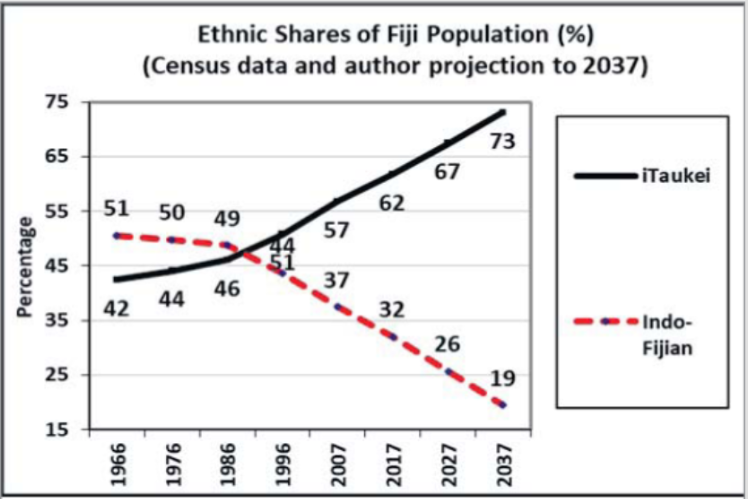
Given that Fiji is the only country in the world to house iTaukei, I can well understand that once upon a time ethnonationalists did have cause to fear being outnumbered in Fiji by Indo-Fijians, leading to the first 1987 coup (see the graph before 1990 when Indo-Fijians did outnumber iTaukei).

But because of their massive emigration since the coups, and lower fertility and birth rates, the Indo-Fijian population has been catastrophically declining.

The graph here shows that just over 26% currently, in ten years time Indo-Fijians will be less than 19% of Fiji’s population and still dropping fast. The iTaukei proportion will be 73% and continue rising forever ensuring their control of government. The military have always been more than 90% iTaukei. So what is the fuss all about?

The tragedy for the once valuable sugar industry is that the hard underpaid work once done by Indo-Fijians, now needs imported labourers from Bangladesh while there is paradoxically serious underemployment and unemployment among the iTaukei.

Researchers might wish to explore that even the past population projections based on the 2017 Census are gross over-estimates because of the massive emigration of Fiji people in the last ten years.

The latest data from the FBS’ 2023-24 Employment and Unemployment Survey indicates that Fiji’s population, far from approaching one million by now, is currently less than 846 thousand and still falling.

The way forward

May I suggest that at the next General Elections, there be an extra Referendum Ballot paper which asks all voters (tick one box):

Should the Fiji Constitution call Fiji citizens

“Fijians” OR “Fiji Islander” OR “Don’t care”.

If any of these three choices gets more than 50% of the votes, responsibility for this decision will be on ALL voters of Fiji, not on Governments, or political parties, or Parliament, or the GCC, or anyone else for that matter.

Fiji can stop wasting valuable emotional energy and time on an irrelevant “name game”.

PROFESSOR WADAN NARSEY is a former Professor of Economics at The University of the South Pacific.

Professor Wadan Narsey makes a request: March 2026.

17 Tuesday Mar 2026

Posted by fijipensioners in Articles & Reports, Press Releases

≈ Leave a comment

Tags

democracy, finance, investing, news, pension, personal-finance, politics, retirement-planning


I request Prime Minister Sitiveni Rabuka to note that the FNPF, for the first time, has admitted that a Pension Buffer Fund (PBF) had been established in 1975 and also that it had also been invested for income like all other funds in its possession (FNPF Statement, The Fiji Times, March 7, 2026).

In many of my previous articles I had pointed out (as had the late Jackson Mar independently) that with the proper crediting of interest income, the Pension Buffer Fund had accumulated to more than enough in 2011 to pay the 2012 Pensioners without drawing on the funds allocated to the General Members or drawing on government subsidies.

This last FNPF statement, in response to the article by Daniel Fatiaki and me, falsely denied this latter basic fact while still alleging, falsely, that for FNPF to make full restitution to the 2012 Pensioners, they would need to draw on funds belonging to the General Members or Government.

The FNPF statement of March 7, 2026 went on to speculate on a whole range of solvency issues, nothing to do with the claims by the 2012 Pensioners for fulfilment of their lawful contracts with FNPF, unilaterally broken by FNPF in 2012. There is no need to discuss these other issues which are mere red herrings thrown up by the FNPF management and board.

Here I draw on FNPF’s own statement of March 7, 2026, admitting the existence of the Pension Buffer Fund, and my estimates of its likely size in 1999, 2011 and 2025.

I also regret that the FNPF board and management are now acting like accessories justifying the illegal theft of the 2012 Pensioners’ lawful property.

The Pension Buffer Fund (PBF) set up by Parliament

FNPF has now acknowledged that the PBF was set up by the Ratu Mara Government in 1975 through parliamentary approval for a 2 cents injection from all FNPF members.

Of course, it could be seen as “unfair” to those FNPF members contributing, but who would eventually not take the pension option when they reached 55.

But the primary objective of the Ratu Mara Government was to encourage those retiring at age 55 to take the pension option which would support them until the end of their lives, rather than take the lump sum which in Fiji tended to be frittered away all too soon.

Most importantly, the decision to set up the PBF was a parliamentary decision and therefore the “law” which has to be obeyed, not the views of actuaries seeking generous income from FNPF or World Bank experts who are never accountable to local people anywhere in the world.

The late Jackson Mar and myself have independently estimated that by 1999, the PBF with interest would have accumulated to $535 millions, when pension annuities that year were less than $25m annually.

Clearly, the PBF even then was more than capable of paying another 20 years of pensions without resorting to General Members’ Funds or Government subsidies.

So quite sensibly, the 2 cents injection into the PBF was stopped by Parliament in 1999 and that was also the law and had to be obeyed.

What was also passed by Parliament in 1999 was the higher pension annuity rates steadily coming down from 25 per cent to 15 per cent (by 1 percentage point per year), which I had argued against when I was in the Fiji Parliament in 1999.

I had stated then (and it is in the Hansards records) that the Pension Annuity Rate should have been reduced immediately to 15 per cent, but Parliament decided otherwise. Those higher relatively generous Pension Annuity Rates also were approved by Parliament and became the law.

But the PBF kept growing

Despite the high annuity rates and pensions paid, the PBF kept growing, especially if it had been credited properly with interest.

How utterly outrageous that the FNPF statement (FT March 7, 2026) claims “the assertion that interest should have been credited to the PBF has no basis in law. The PBF was not a separate ring-fenced account owed exclusively by pensioners.”

Hullo, we have never said the PBF was “owned” by pensioners. We have said the PBF was set up by the Fiji Parliament precisely for the purpose of paying pensions and receiving the lump sums of those reaching 55 and choosing the pension option.

The FNPF statement (March 7, 2026) itself acknowledges that the PBF “formed part of the over-all pooled investment fund. All assets were invested collectively and investment income was managed as part of the broader fund reserves”.

Clearly, those funds allocated to the PBF by the Fiji Parliament decision through the 2 cents injection were also earning income. So why should there be any law to stipulate that the PBF should have received interest? Why should the PBF be denied the same interest that was credited to other funds invested by the FNPF?

We point out that by 2011, the PBF ought to have had around $903m, when the total pensions being paid out was a mere $49m, i.e. the FNPF even then was in a position to pay another 18 years of pensions at that level – more than enough given that average life expectancy was only around 65 for males and 67 for females.

It was therefore outrageous for FNPF to claim in 2012 that the PBF would run out in just a few years (as they did in a graph) in order to justify their reduction of the Pension Annuity Rate from 15 per cent to 8.7 per cent.

We do not dispute FNPF reducing the PAR to 8.75% after 2012

Let us be clear that the 2012 Pensioners do not dispute the right of FNPF to reduce the Pension Annuity Rate after 2012 to 8.7 per cent, but that should have been applied only to new retirees at age 55.

What the 2012 Pensioners disputed and took to court was FNPF’s decision to apply that reduction of Pension Annuity Rate to existing pensioners who had lawful contracts signed with FNPF on the 9NOP forms, which declared that they could not change their minds after they signed that Form 9NOP.

FNPF strangely went against the advice from one of their ethical actuaries (Shona Tomkins from firm Promontory) who had stated that reduction of existing pensions would be against “the law of contracts”.

But FNPF callously ignored that sensible advice. Although in a Key Features Statement clearly admitted their guilt when they tried to assure future new retirees “The rates in Table 1 will be regularly reviewed by the FNPF board subject to actuarial advice. Any change in rates in the future will only affect new purchasers, not those who have already purchased the product.”

Ha ha ha. too late for the 2012 Pensioners?

While the FNPF called the reduction of pensions a “reform” it resulted in a total disaster which the FNPF (board and management) to this day have still not acknowledged despite what they can see with their eyes: the total collapse of the Pension Take Up Rate to below 4 per cent by those reaching age 55.

Today, 98 per cent of all retirees at age 55 (yes, 98 out of every 100 new retirees) refuse to take the pension option, but take their lump sums. They do not trust the FNPF after the 2012 robbery.

No amount of costly “rebranding” by the FNPF management and board is going to take away that disastrous reality of totally collapsed Pension Take Up rates. No amount of lipstick on a pig will change the fact that it is a pig.

Note that the FNPF board and all its members blatantly ignore the collapse of the Pension Take Up Rate: It is not even mentioned in their annual reports.

Instead, both FNPF board members and senior management in 2011 went on a propaganda rampage alleging that the FNPF would be made insolvent unless they reduced not just the pension rate for future retirees, but also existing pensioners.

The FNPF article of March 7, 2026, is still making those fallacious arguments against the 2012 Pensioners’ claims when it was abundantly clear that the PBF had more than enough in 2012 to pay the existing pensions without drawing on General Members funds.

We have also shown that the PBF in 2025 with interest credited would have around $1382m.

This massive sum is far more than needed to pay for full restitution of the 2012 Pensioners (backpay plus ongoing pensions at the pre-2012 rate), and still leave some $800m for General Members and the FNPF solvency reserves.

So why do the FNPF board and management keep repeating the falsehood that the General Members or Government will have to “cross-subsidise” the 2012 Pensioners?

Other irrelevant FNPF arguments

Throughout the FNPF statement, over and over, there are claims of FNPF after 2012 needing to satisfy “solvency requirements” set by international “authorities” like World Bank or actuaries.

There is ample data to show that FNPF has never lacked for adequate liquidity.

I see no need to address these arguments as they are totally irrelevant to the claims of the 2012 Pensioners which are based entirely on the illegal trashing of their lawful signed contracts with FNPF (clearly pointed out by former Chief Justice Daniel Fatiaki) and the adequacy of the Pension Buffer Reserve (pointed out by the late Jackson Mar and myself).

FNPF Employees and Board now” accessories” to a robbery

More than a year ago, the FNPF chairman (Daksesh Patel) had lamented to me that while he fully sympathised with the 2012 Pensioners, his “hands were tied” by the 2011 Decrees.

But with this FNPF statement of March 7, 2026, it is clear now that the FNPF management and board members are willing to be accessories to the FNPF’s criminal seizure of the property of the 2012 Pensioners by using all kinds of false arguments to justify it.

Far from being FNPF employees and board members accountable to all FNPF members including the 2012 Pensioners, they have become accessories justifying the 2012 restructuring which the previous Minister of Finance called “illegal”.

Why address PM and not the Minister of Finance?

Why am I addressing Prime Minister Rabuka in this article and not the new Minister of Finance?

Sadly, even though the previous Minister of Finance (Professor of Economics Biman Prasad) had labelled the FNPF action against the 2012 Pensioners as “illegal”, the recent statement by the new Minister of Finance suggests that he does not have the financial acumen to understand the intricacies of FNPF lies about the 2012 Pensioners’ claims.

The new Minister of Finance still calls the 2012 restructure “reforms” the way the FNPF board and management have done consistently.

The new Minister of Finance does not seem to understand that he should not even have issued that statement he did a few weeks ago given that the 2012 Pensioners’ claims are not against Government, but against the FNPF.

Indeed, what role did the FNPF board and senior management have in that statement by the new Minister of Finance?

It is tragic that while the board and FNPF management are supposed to be accountable to all FNPF members and pensioners (including the 2012 Pensioners) they have steadfastly refused to be accountable.

When the previous Minister of Finance (Professor Prasad) had informed me a few months ago that he would consider some compromise solution, I had requested anonymous data on an Excel spreadsheet from the FNPF board on the approximate numbers of 2012 Pensioners, their monthly pensions and their ages, in 2012 and 2025.

I have been contemplating some compromise equitable solution which would fully restore all the low income pensions (including their backpay by three instalments) and put some moderate monthly cap on well-off pensioners so as to reduce the total financial liability for FNPF (I had suggested a cap of around $5000 per month). I am confident most high income pensioners would accept some compromise in order to benefit the low income pensioners.

Sadly, despite all their grand claims in their Vision and Mission Statements about accountability, both the FNPF board and the Minister of Finance have declined to provide me with this information which has absolutely nothing confidential.

How extraordinary and arrogant that FNPF declares in its March 7, 2026, statement “The FNPF does not intend to make further public comments in this matter.”

May I request the Prime Minister Sitiveni Rabuka to consider the facts that are in this article and discuss a constructive way forward with his new Minister of Finance, the FNPF board chairman and the 2012 Pensioners’ Core Group (chaired by Ross MacDonald) perhaps with the previous Minister of Finance in attendance given that he would understand all the financial issues discussed here.

← Older posts

Subscribe

  • Entries (RSS)
  • Comments (RSS)

Archives

  • October 2026
  • August 2026
  • June 2026
  • May 2026
  • April 2026
  • March 2026
  • February 2026
  • January 2026
  • December 2025
  • November 2025
  • October 2025
  • September 2025
  • August 2025
  • May 2025
  • January 2025
  • December 2024
  • November 2024
  • August 2024
  • July 2024
  • February 2024
  • December 2023
  • September 2022
  • June 2022
  • February 2021
  • August 2020
  • February 2020
  • October 2018
  • September 2018
  • March 2018
  • January 2018
  • December 2017
  • October 2017
  • June 2017
  • May 2017
  • November 2016
  • July 2016
  • June 2016
  • March 2016
  • February 2016
  • January 2016
  • December 2015
  • November 2015
  • October 2015
  • September 2015
  • August 2015
  • July 2015
  • June 2015
  • May 2015
  • April 2015
  • March 2015
  • February 2015
  • January 2015
  • December 2014
  • November 2014
  • October 2014
  • September 2014
  • August 2014
  • July 2014
  • June 2014
  • May 2014
  • April 2014
  • March 2014
  • February 2014
  • January 2014
  • December 2013
  • November 2013
  • October 2013
  • September 2013
  • August 2013
  • July 2013
  • June 2013
  • May 2013
  • April 2013
  • March 2013
  • February 2013
  • January 2013
  • December 2012
  • November 2012
  • October 2012
  • September 2012
  • August 2012
  • July 2012
  • June 2012
  • May 2012
  • April 2012
  • March 2012
  • February 2012
  • January 2012
  • December 2011
  • November 2011
  • October 2011
  • September 2011
  • August 2011
  • July 2011

Categories

  • Articles & Reports
    • Link Information
  • Daily Humour
  • Health Hints
  • Letters
    • Grey Power Editor
    • Letters to FNPF
    • Unpublished Letters
  • OBITUARIES
  • Polls & Surveys
  • Press Releases
  • Quotations
    • Remembrance
  • Recipes

Meta

  • Create account
  • Log in

Create a free website or blog at WordPress.com.

Privacy & Cookies: This site uses cookies. By continuing to use this website, you agree to their use.
To find out more, including how to control cookies, see here: Cookie Policy
  • Subscribe Subscribed
    Fiji Pensioners
    Join 35 other subscribers

    Have a WordPress.com account? Log in now.

  • Fiji Pensioners
    View site in Reader
    Manage subscriptionsSign upLog in
    Report this content
    Collapse this bar
Loading Comments...