FNPF MAKING EXCUSES YET AGAIN

THE Fiji National Provident Fund Decree 2011 requires the Fund to set up two accounts for all members — Preserved and General —which basically means your total savings will be divided into these two accounts with particular restrictions on its use.

The Fund revealed earlier the implementation date for this process was January 2013 but chief executive officer Aisake Taito yesterday revealed necessary systems and business processes need to be in place before its actual implementation.

“The (FNPF) decree was promulgated on November 25, 2011. The fund is currently implementing provisions of the decree but members will continue to access their funds (as is the current practice) according to the provisions of the decree,” Mr Taito said.

“FNPF is a retirement fund and our core role is to ensure members accumulate savings for a meaningful retirement.”

Those particularly concerned about how these two accounts would affect their pension after retirement, Mr Taito assured the total funds in the Preserved and General accounts will be made available should a member decide to retire either at 55 years or later.

“The member has the choice on how he or she wishes to allocate this sum into the various retirement products FNPF provides which includes a full lump sum withdrawal,” he clarified.

According to a Fact Sheet from the fund, members will be advised well in advance of the implementation date of these two accounts.

“The Preserved account, which will constitute 70 per cent of your total savings with FNPF, will be set aside for your pension.

“As a pension fund, the FNPF must ensure that members have enough funds set aside for this purpose,” the fund said.

The General account, which will make up the remaining 30 per cent of a member’s balance, can be assessed for partial withdrawal under approved grounds like education, medical, housing, funeral and unemployment assistance.

Ideally, the Fact Sheet also includes tips for first time property buyers who will be allowed to access up to 30 per cent of their Preserved account if they are applying for assistance to buy their first property — be it a new home or a piece of land.

“This will be in addition to the 30 per cent from your General account thus you can access 51 per cent of your total FNPF savings (30 per cent plus 30 per cent of the 70 per cent) for this purpose,” the fund said.


CONFESSION

An elderly man walks into a confessional.
The following conversation ensues:
Man: ‘I am 92 years old, have a wonderful wife of 70 years, many children, grandchildren, and great grandchildren. Yesterday, I picked up two college
girls, hitch-hiking. We went to a motel, where I had sex with each of them three times.’
Priest: ‘Are you sorry for your sins?’
Man: ‘What sins?’
Priest: ‘What kind of a Catholic are you?’
Man: ‘I’m Jewish.’
Priest: ‘Why are you telling me all this?’
Man: ‘I’m 92 years old …. I’m telling everybody!’

Google adds coral reef panoramas to Street View maps

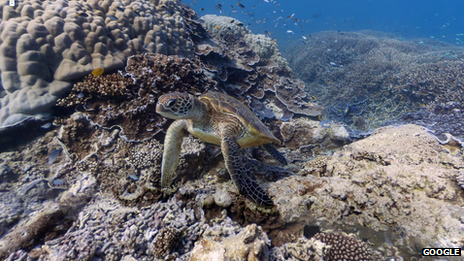
Panoramic images of several coral reefs have been added to Google’s Street View service in its maps, allowing users to navigate their way around the sites.

The material was gathered by the Catlin Seaview Survey – a project studying the health of the reefs, including the impact of global warming.

The programme’s director said the effort would help scientists analyse ecosystems and raise general awareness.

It is also a publicity coup for Google at a time of growing competition.

Google has previously offered computer-generated views of the sea floor terrain, but this is the first time it has incorporated underwater photographs into its mapping product.

“We want to be a comprehensive source for imagery that lets anyone explore anywhere,” Jenifer Foulkes, Google’s ocean programme manager, told the BBC.

“This is just the next step to take users underwater and give them the experience of an area that most people have been been to – seeing sea turtles, seeing manta rays, crazy pencil urchins and beautiful fish.”

Locations added to the service include Australia’s Great Barrier Reef near Heron Island, Lady Elliot Island and Wilson Island, as well as Hawaii’s Hanauma Bay and Molokini Crater and the Philippines Apo Island.

Laughing ‘better than latest technology for leg ulcers’

A good old belly laugh can help heal leg ulcers, experts say.

The Leeds University team said good nursing and the occasional laugh was a better way to get the body healing than using the latest technology.

Hospitals and health clinics are increasingly using low-dose ultrasound for leg ulcers.

But the five-year study of 337 patients found it did nothing to speed up recovery, the British Medical Journal reported.

‘Hearty chuckle’

Instead, lead researcher Professor Andrea Nelson said: “They key to care with this group of patients is to stimulate blood flow back up the legs to the heart. The best way to do that is with compression bandages and support stocking coupled with advice on diet and exercise.

“Believe it or not, having a really hearty chuckle can help too. This is because laughing gets the diaphragm moving and this plays a vital part in moving blood around the body.”

During the study, the team concentrated on patients with hard-to-heal ulcers that had not cleared up after six months or longer.

They found that adding ultrasound to the standard approach to care – dressings and compression therapy – made no difference to the speed of healing or the chance of ulcers coming back.

Old Timers Sex

This is too funny to be dirty – enjoy!
The husband leans over and asks his wife, ‘Do you remember the first time we had sex together over fifty years ago? We went behind the village tavern where you leaned against the back fence and I made love to you.’
‘Yes’, she says, ‘I remember it well.’
‘OK,’ he says, ‘How about taking a stroll around there again and we can do it for old time’s sake?’
‘Oh Jim, you old devil, that sounds like a crazy, but good idea!’
A police officer sitting in the next booth heard their conversation and, having a chuckle to himself, he thinks to himself, I’ve got to see these two old-timers having sex against a fence. I’ll just keep an eye on them so there’s no trouble. So he follows them.
The elderly couple walks haltingly along, leaning on each other for support aided by walking sticks. Finally, they get to the back of the tavern and make their way to the fence… The old lady lifts her skirt and the old man drops his trousers. As she leans against the fence, the old man moves in.. Then suddenly they erupt into the most furious sex that the policeman has ever seen. This goes on for about ten minutes while both are making loud noises and moaning and screaming. Finally, they both collapse, panting on the ground.
The policeman is amazed. He thinks he has learned something about life and old age that he didn’t know.
After about half an hour of lying on the ground recovering, the old couple struggles to their feet and puts their clothes back on. The policeman, is still watching and thinks to himself, this is truly amazing, I’ve got to ask them what their secret is.
So, as the couple passes, he says to them, ‘Excuse me, but that was something else. You must’ve had a fantastic sex life together. Is there some sort of secret to this?’
Shaking, the old man is barely able to reply, ‘Fifty years ago that wasn’t an electric fence

Wise Up Neil Sharma MP

Stop the fluoridation of water

I WAS sorry to read in The Fiji Times Online (21/9) that Fiji is continuing with its water fluoridation program, despite it being completely discredited in most of the world as unethical, unscientific, costly ($1 million will be a drop in the ocean) and worst of all, injurious to the health.

Harvard Medical School researchers recently published a paper (Environmental Health Perspectives 20 July 2012) demonstrating a loss of an average 7 IQ points by children up to age 14 in fluoridated communities.

The loss is greater among poorer communities with lower nutritional standards.

I don’t believe anyone could deny the credibility of this university.

Other proven consequences include kidney disease, iodine deficiency leading to hyperthyroidism and brittle bones.

On top of all this, any benefit to the teeth in reducing cavities is statistically insignificant and more that offset by fluorosis staining and mottling the teeth. Please stop this program now and get your $1 million back.

PETER MACKINLAY Geelong
Australia

Read more facts on Fluoride~http://www.fluoridealert.org/articles/iq-facts/

Read even more ~ http://www.angelfire.com/az/sthurston/fluoride.html

THE MYZOMELA

As I approached my car to go shopping one day three years ago, I saw a tiny bird fluttering, as a hummingbird might do, in front of a wing-mirror. The little thing wasn’t fazed at all by how close I was. Every now and then it would cling to the mirror’s rim and chirp away to itself. Sometimes it hung upside down from one leg. 

That was just too good to ignore, so the next day I drove to Navua to purchase four 6 by 4 inch mirrors. My husband attached three to the courtyard fence, and one to a fence post beside the master bedroom and visible from the living room patio. Below the bottom of each mirror he nailed a 6 inch nail to make a perch. 

Then I waited. It took about 4 weeks for ‘Little Bird’ to discover the first mirror; the one placed beneath an odd looking plant that bears red flowers. I’d noticed that it was particularly fond of red flowers. Just a week later it found the bedroom mirror and its chirruping would call me to lurk behind the curtain and watch its antics just eight feet away. 

A Google search informed that it was a myzomela, or orange-breasted honey-eater, and endemic to Fiji. It’s approximately 4 inches long, with a black back, some red on its tail, a creamy breast tinged with yellow rather than orange, and a black head on which the male sports a round red cap, just like my ‘Little Bird’. Happily it is far from endangered. 

One day, when I was watching it from the patio, I looked up from my book and there it was, hanging motionless. My heart sank as I stood and very slowly walked towards it. I was not five feet away when it suddenly took off into the air chirping like crazy. This became a favourite trick, hanging like a dead thing from its perch, and it was always un-nerving. 

Occasionally, Little Bird would fly into the house and perform before the mirror above the dining room buffet, often landing on the fan blades or perching on a light fitting or beam, chirruping away. 

Little Bird soon found a Mrs Little Bird and they provided much amusement when they chased each other, flying in their dipping fashion and perching in the neighbour’s orange tree. They are rarely still, these little birds, unless they are hanging upside down, that is. Up in the tree’s branches they were always in constant motion, jumping this way and that and keeping up a high pitched tweeting. 

Then they vanished, and I assumed that Mrs Little Bird was producing a Baby Little Bird. It was about 6 weeks before I heard their characteristic cheeps, looked up, and there they were – three Little Birds! But they didn’t stay together for very long. Soon, Little Bird was on his own again and entertaining me with his antics. Then he was gone again, this time for almost three months. 

It was on a very hot morning that I heard an exceedingly loud cheep that seemed to come from high up in our beamed ceiling. And sure enough, there was a very tiny Myzomela, all fluffed up, sitting on the cross beam. It cheeped again, and repeated its loud cheep at about 5 second intervals. This bird was clearly not Little Bird. 

Shortly before noon it began to fly down every now and then, to a fan-blade to sit, cheep, and fly up again. By lunch-time we were very hot indeed but we couldn’t turn on the fans in case the bird flew into it. So we retired to the patio to sit it out. Wattled honey-eaters fly into the house every now and then. Unlike minahs and bulbuls, which find their way out quickly, they are not street smart and have to be ignored until dusk, when invariably they find their way out. We hoped this would be how this tiny creature would leave, too. 

But mid-afternoon, with our ears ringing from the echoing cheeps, we heard an answering cheep from a garden opposite. Two myzomelas were having a conversation. All at once, there was a flurry of feathers and we watched in amazement as what was certainly Little Bird flew directly into the house – up to the beam and fed his little one.

He flew out of the house and back several times to feed the baby; then he changed tactics. He flew in without food, winging up to the baby and down again – out through to the patio, then back up; and we realised that he was trying to get the baby to follow him outside. Eventually it did move down to a fan-blade, and Little Bird left it there and flew off for more food. 

The feeding continued until dusk was approaching, so we decided to open all the doors and windows wide, placed two jardinière stands beside each set of double doors to make them look invitingly gardenish, and vacated the living area. Half an hour later, with darkness falling, we returned to find that the birds had flown. 

We never saw Little Bird again. But Baby Little Bird has found the mirrors and is now a frequent visitor. It still prefers to sing single cheeps and he is not nearly so entertaining as his daddy. He simply contents himself hopping left and right on the perches and I have yet to catch him hanging upside down. He is also a little shorter and fatter than his daddy, and his beak is not quite so long. 

Baby Little Bird is a part of the household now, along with the mongoose family that lives beneath the patio – the skink that lives under the living room chairs – and the pair of minah birds that walk through the house several times a day. 

So if you would like to attract myzomelas into your garden or onto your balcony, a mirror will do the trick. I thought that inexpensive plastic-framed mirrors would become crazed and dull in no time if left out in the weather, but they are lasting very well indeed. Such a lot of joy for so very little. 

Sue Cauty


How is Norma ?

A sweet grandmother telephoned St. Joseph ‘s Hospital. She timidly asked,
“Is it possible to speak to someone who can tell me how a patient is doing?”

The operator said, “I’ll be glad to help, dear. 
What’s the name and room number of the patient?”

The grandmother in her weak, tremulous voice said,
“Norma Findlay, Room 302.”

The operator replied,
“Let me put you on hold while I check with the nurse’s station for that room.”

After a few minutes, the operator returned to the phone and said,
“I have good news. 
Her nurse just told me that Norma is doing well. 
Her blood pressure is fine; her blood work just came back normal, and her physician,  Dr. Cohen, has scheduled her to be discharged tomorrow.”

The grandmother said, “Thank you. That’s wonderful. I was so worried. 
God bless you for the good news.”

The operator replied,
“You’re more than welcome. Is Norma your daughter?”

The grandmother said,  “No, I’m Norma Findlay in Room 302.
No one tells me shit.”