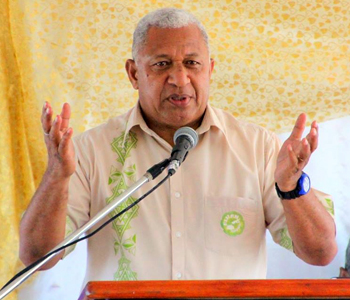
Parliament in Chaos

The Fiji Parliament under the rule of the person now known as King Khaiyum has become less of a debating chamber and more of a Big Stick Arena, how much worse can it possibly get…

Suspension of indigenous MP in Fiji underlines government’s stranglehold on freedom of expression

3 June 2016, 16:28 UTC

The Fijian parliament must overturn the suspension of an opposition MP for merely exercising her right to freedom of expression, Amnesty International said today.

“Parliaments can only be worthy of their name when all members can speak freely on all issues,” said Rafendi Djamin, Amnesty International’s Director for South East Asia and the Pacific.

“Unless this suspension is immediately reversed, the Fijian authorities are proving they are intent on silencing critical voices.”

Tupou Draunidalo, an indigenous Fijian parliamentarian and member of the National Federation Party, was suspended following a parliamentary motion on 3 June 2016 for calling a government minister “a fool” while responding to comments deriding opposition members of parliament.

Draunidalo asked the government minister if he was suggesting herself and other indigenous members of the opposition were “dumb natives”.

Under the terms of the suspension, Draunidalo will not be able to sit in parliament for the remainder of its term. She was elected to parliament in September 2014, in Fiji’s first election in eight years.

The suspension underlines the Fijian authorities’ ongoing hostility to criticism, including persistent and wide-ranging restrictions on what journalists can report.

Since 2010, Fiji’s media has been subject to undue restrictions laid out in ‘The Media Industry Development Decree,’ which includes potential imprisonment for news editors who do not uphold “the national interest.”

“If Fiji is serious about its bid for the UN Human Rights Council, they must demonstrate they are serious about upholding human rights at home,” said Rafendi Djamin.

“Letting Draunidalo take up her rightful place in parliament, with all due protections for her right to freedom of expression, will be an important first step.”


https://www.amnesty.org/en/latest/news/2016/06/fiji-suspension-of-parliamentarian-underlines-government-stranglehold-on-freedom-of-expression/

Decree 51 was and still is a Crime

Prof WN

Report commissioned by David Fowler Burness v Fiji National Provident Fund and Republic of Fiji and the Attorney General of Fiji Civil Action: HBC No 183 of 2011

Professor Wadan Narsey

School of Economics

Faculty of Business and Economics

The University of the South Pacific

1. I, WADAN LAL NARSEY of 27 Gardiner Road, Nasese, Suva state as follows:

I have been requested by David Fowler Burness to provide an economic analysis in relation to the proposal of the Fiji National Provident Fund „Board‟ to reduce the pensions of FNPF beneficiaries, including David Fowler Burness, the Applicant in the action for human rights redress pursuant to section 38 (5) of the Human Rights Decree.

I am qualified to make this report, having a number of relevant university degrees (a Bachelors Degree in Mathematics and Science from the University of Otago, a Masters Degree in Economics from the University of West Indies (Jamaica) and a DPhil from the University of Sussex in UK) and having analysed and written on the problems associated with the FNPF for many years.

In addition, I have the following work experience (with the details provided in my CV):

1.0 Employment and significant publications:

1972: Fiji Islands Bureau of Statistics;

1973: the University of the South Pacific ( lecturer in Mathematics and, later, Economics).

I have been employed at USP since then, including three years as USP‟s Director of Development and Planning (1993 – 1996)

1996: Elected unopposed into Parliament until 1999 when I returned to USP.

From 2004- 2007 semi-retired independent consultant.

From 2007 to current- USP‟s Professor in Economics.

Over the past 38 years I have conducted numerous consultancies for regional governments, donors, regional and international organizations. In the last ten years, my consultancy and research work has focused on Fiji and Pacific development problems and applied policy. 2

Recent books published:

(i) Just Wages in Fiji (for ECREA)

(ii) Poverty in Fiji ( for Fiji Islands Bureau of Statistics)

(iii) Gender issues in Employment and Unemployment in Fiji (for AusAID and FIBoS).

(iv) Numerous other publications in eminent journals and books too many to mention but can be supplied upon request.

I have extensive workshop and training experience in Fiji and the Pacific on the subjects of poverty alleviation, social justice and civic responsibility, employment and unemployment, gender, regional trade, and development issues in general.

I have written more than a hundred articles for the Fiji media, on economic, political and social issues, including many on the problems of the FNPF (see the attached CV).

2.0 Professional Credentials and Appointment to Government Boards (1999-2005)

In 1999, I was appointed by the Fiji Government (led by the Fiji Labour Party then) on the

Fiji National Provident Fund Investment Committee, on which I served for three years.

I was also appointed by the same government on the Asset Management Bank Board (tasked with recovering the “bad debts” resulting from the National Bank of Fiji disaster) on which I also served for the full three years.

In 2004 I was appointed by the SDL Government on the Board of FIRCA (Fiji Islands Revenue and Customs authority) from which I resigned on issues of principle.

I have also made presentations to numerous Fiji Government Cabinets in respect of major development projects for the SDL/FLP Multi-party Cabinet, as well as on poverty and poverty alleviation issues in Fiji (the latter with a team from the Fiji Islands Bureau of Statistics).

Three years ago I was also invited by Commodore Bainimarama to chair the FNPF Board, which offer I declined on principle, as I informed him that I was personally opposed to military coups removing elected governments, since my personal economic analyses of previous coups had led me to the conclusion that they did great economic, political and social harm to our country.

I have disclosed to Mr Burness the fact that I am the recipient of an FNPF pension (ie a beneficiary) but have also disclosed that I have written as an economist, on issues pertaining to FNPF since 2002, that is, prior to my receiving the pension, while contributing on the 1998 FNPF Amendment Act in Parliament. 3

3.0 Questions asked by Mr Burness

I have been asked to address a series of specific questions, as follows:

Question 1

Question 1 (a) Can FNPF pensions be legally reduced?

Answer: No they cannot be, pursuant to the FNPF Act.

Question 1(b) Can FNPF vary the pension rates differentially for high/low income pensioners?

Answer: The FNPF Act states they cannot.

Question 1(c) Does FNPF have the financial capacity to pay existing pensions at their current rates?

Answer: The provisions of the FNPF Act and the existence of the Buffer Fund, which has wrongly been denied interest payments from 1975 to the present, suggest without any doubt that they do have capacity to pay, for another 18 years or more.

Question 2:

Should there be an official inquiry into the Fiji National Provident Fund in relation to investments, related issues with respect to the Burness legal action, and the planned implementation of the review by the FNPF and on what economic basis?

In my report below, I outline the many reasons (including possible actuarial errors by the ILO and Mercer studies) why an Expert Commission of Inquiry is necessary to make certain recommendations which may then be considered by an elected Government.

4.0 FNPF issues prior to 2006 – economic analyses

FNPF has been larger, in total, than all the other private financial institutions put together. FNPF, is the biggest lender to the Fiji Government, as well as the largest player in the financial market. By purchasing majority shares in ATH, FNPF also became the biggest stakeholder in the telecommunications market, with its numerous monopolies, which have constrained the Fiji economy for decades, particularly in the last twelve years under FNPF influence.

I have published a number of articles, on how FNPF has over the decades come to its current crisis. These can be supplied upon request, as follows: 4

In “The ATHL monopoly: between the devil and the deep blue sea”, The Fiji Times, 6 March 2002, I wrote:

How FNPF’s purchase, at an extremely inflated price, of majority shares in the ATH

super monopoly condemned to a quandary where to protect its investment, it would

have to squeeze maximum dividends out of its ATH shares, and hence the maximum

from Vodaphone, Telecom Fiji and FINTEL (over which it only obtained “management rights”, not actual ownership of shares. The PS Finance then (Narube)

was also then the Chairman of the FNPF Board.

In the “The Reserve Bank and the FNPF: funny business for the guv”. The Fiji Times, 12 March 2002 I pointed out:

The massive conflicts interest for the Governor of the Reserve Bank who

was also appointed as Chairman of FNPF and he also accepted Chairmanship of

FINTEL: with the RBF forcing FNPF to bring back its investments (thereby losing

revenue and risk minimisation for FNPF), RBF’s role as regulator of Fiji’s financial

system while FNPF was a huge player in the financial market, etc. A similar conflict of

interest was also always there with the Permanent Scretary of Finance, or other

Permanent Secrataries being appointed as Chairman of the FNPF Board.

In “Communications Monopoly monsters at work” The Fiji Times, 21 May 2004, I wrote:

How the communications monopolies were doing huge damage to Fiji economically

and socially, and FNPF, to gain short-term dividends, was harming itself in the long

run by supporting monopolistic practices which squeezed the economy, reduced

economic growth and job creation and thereby squeezed its own long-term growth in

contributions from existing and new members.

In “Auditors between the devil and the deep blue sea”. The Sunday Times, 14 August 2005, I wrote:

that the implications of the Professor Michael White’s analysis of FNPF

accounts by auditors on how FNPF would appear to be far worse if proper

accounting procedures were to be followed in respect of the massive premium paid by

FNPF for ATH shares, and the likely loss of value once competition was brought into

the telecommunications industry. This was a very prophetic article, as well the

analysis by Professor White.

In “Stock markets, sharks, suckers and victims”. Islands Business, May 2006 I wrote:

While stakeholders in the Fiji Stock Exchange had been attempting to encourage the

public to convert their savings into shares in the stock market, it points to

the dangers lurking in the future, especially if governments, under pressure from

WTO or just a good change in policy, try to reduce monopolies, such as cement

producing companies, or ATH. There would be inevitable losses in share value, 5

which stock market stakeholders were not pointing out. FNPF had even been

encouraging, in my view wrongly, its members to use their FNPF money to buy

shares in ATH, the monopoly.

5.0 Post 2006

Since the events of 2006, there have been massively increased government borrowings from the FNPF, and massive losses in some large investments.

I have written the following articles, which have had direct or indirect bearing on the FNPF:

“Coup wolves circling FNPF” Fiji Sun, 14 March 2009 and The Fiji Times 13 March 2009.

Early warning: Fijian Holdings Limited, a company controlled by the Military

Government, tried to borrow more than a hundred millions from FNPF, when private

banks had refused. Thankfully, FNPF refused. More ominously, the Military

Government wants to borrow hundreds of millions, basically to sustain their increased

recurrent expenditure and military over-spending. The private banks, local or overseas,

will not oblige. Should FNPF oblige? Will FNPF oblige? If FNPF continuously gives in

to such lending pressures from Government, without economic growth, it will only

encourage inflation to rise in the long term, thereby slashing the real value of everyone’s

savings and pensions. And if ever pensioners totally lose confidence in FNPF, it may

become insolvent, with future pension rates slashed, and even existing pensions reduced

in dollar terms. The key issue is that the FNPF Board is now controlled by an unelected

Military Government’s appointees and we the FNPF contributors who own the savings do not have a single direct representative on the FNPF Board who can be accountable to us.

In “Saving FNPF and Fiji” 12 May 2010 (Pacific Scoop- online media), I wrote:

Worrying news about Fiji National Provident Fund (FNPF) and the Reserve Bank of Fiji

(RBF). FNPF announced a $327 million “write down” in its investment value (with

some $300 million of that due to the Natadola loan). But FNPF also has some other large

exposures which are not looking good: Momi, FSC and other private sector borrowers.

And very strange that RBF has lent $22 million to the Fiji Sugar Corporation (FSC).

These are all extremely worrying developments for FNPF, RBF and for Fiji. Urgent need

for Public Inquiry. How did these massive losses take place? Who should be held

responsible? Might it get worse for FNPF? And how should FNPF management be

strengthened to prevent further unwise decisions?

In “Helping FNPF, despite media censorship”. Pacific Scoop. 18 January 2011, I wrote:

With a stagnating economy FNPF revenues have been severely constrained. Few new

jobs have been created and existing incomes have not grown; many loans are nonperforming; returns on FNPF investments have been declining; and large amounts of

capital values have been written off because of mismanagement. But collectively, FNPF 6

contributors and pensioners remain the largest group of spenders in the Fiji economy.

This article constructively suggested how FNPF contributors and pensioners could direct

their consumption expenditure towards FNPF investments (such as Holiday Inn,the

Intercontinental, and Tappoo City), and change FNPF policies for the better. How FNPF

management could encourage this by providing financial incentives and changing their

management structure. Called on FNPF stakeholders (FNPF itself, unions, pensioners,

civil servants etc) to conduct marketing campaigns in the aid of FNPF assets and loans

recipients.

In “Your money is not fully yours”. The Fiji Times 7 May 2011, I wrote:

..while Fiji citizens technically own their personal monetary holdings, they and their

institutions (like FNPF) are not free to invest it where they wish to- they must obtain RBF

permission to invest abroad. FNPF, which used to keep moderate amounts of their funds

abroad in order to diversify their investments, have also been forced to bring them back,

wherever there have been foreign exchange reserves crises, and suffered losses as a

consequence. Whatever the FNPF loses in income, is gained by the RBF, which passes it

on to the Government of the day, to spend and enjoy. Fiji citizens, who were forced to

keep their investments in Fiji, have paid a heavy price, periodically.

In “FNPF sinks lower” Pacific Scoop. 26 May 2011, I wrote:

That the FNPF symposium being organized by the FNPF and the Miliary Regime was a

farce. The FNPF management and Board, under orders from the Bainimarama Regime,

will continue to hide all the reports that would reveal that the Bainimarama Regime is

itself directly and indirectly responsible for a large part of the mess that the FNPF is

currently in and the urgency of needed reforms; The Bainimarama Regime will continue

to milk the FNPF cow, which, with increased contributions and reduced payouts, will

give them even more of our savings to use ad misuse, however they wish. The

contributors to FNPF and the pensioners of FNPF, will have no choice in the matter.

With media censorship, they cannot even publicly and freely discuss these massive

changes to your pension fund.

Called on the contributors and pensioners of FNPF to demand the public release of all the reports by IMF, WB, ILO and recent independent consultants; demand the release of all the reports on the investigation into the investments at Natadola, Momi; demand that the majority of the FNPF Board Members must be democratically elected by the current

FNPF contributors and with pensioners having separate elected representation; demand

that the Chairman of the Board must be from these elected Members and definitely not

some foreigner as currently; demand that any decision on changes to the FNPF must be

made by the elected Board and not the current Board and Management; demand that

FNPF must be allowed to invest as much of its funds abroad as is prudently advisable and that RBF must recompense FNPF for all the lost earnings because of foreign investments brought back; demand that the FNPF management swear oaths of allegiance to the real owners of the Fund- the contributors and the pensioners, and not to an illegal Military Government. 7

In “Consultants helping the Fiji military milk the FNPF cow”.Pacific Scoop. 2 June 2011 I wrote:

While consultants were recommending significant reductions to the annuity rates for

future pensioners, serious questions may be asked, for example, whether the Mercer

calculations are correct, especially their assumption of Fiji’s future mortality patterns

following Australian patterns. While these consultants and FNPF management talked

about accountability and transparency, and the need to protect “whistleblowers”- they do not apply these same principles to themselves with their data and analysis. The

Promontory recommendations on the “Restructured Board” are a total sell-out of sound

principles of accountability of the FNPF management and Board, to the real owners of

the FNPF. These consultants’ direct involvement in the politically inspired symposium

sadly shows how supposed independent experts will compromise their professionalism

into illegal processes being stage-managed by this illegal Military Regime. These

consultants’ recommendations also make sure that they will continue to earn further

consultancies well into the future.

In “End FNPF subsidy to Fiji Governments- linking the many battles” Pacific Scoop. 20 July 2011 I wrote:

The FNPF Board and Management conveniently ignore that FNPF has been giving large

subsidies (amounting to hundreds of millions over the last forty years) to successive Fiji

governments through easily available loans, at interest rates much lower than that

charged by commercial banks. The legal battle by current pensioners against FNPF and

the Military Regime, should point to these massive FNPF subsidies to Fiji governments

as a moral justification for Fiji Government to finance any future shortfalls in the

liabilities to existing pensioners. To help FNPF’s revenues and current contributors and

pensioners, these interest rate subsidies to Government should also be ended. For that to

occur, both pensioners and contributors need to fight Battle 3, which is to have an FNPF

Board completely accountable to its members. Continue reading

NOT Royal And Ancient Rules

GEtiquette

Give democracy to all golfers (edited version in FT, 20 March 2016)

Wadan Narsey………..

Academics studying the failures of democracy in Fiji, in addition to studying the assaults by Rabuka and Bainimarama on the elected Fiji parliaments, would understand the failures of society better by also examining the failures of democracy in other organizations, such as superannuation funds, religious bodies, social clubs, sports clubs, and national sports organizations.  Golf is one of them.

Fiji Times sports headline (30 January 2016) announced “New Golf Leaders” with the “National Golf Association of Fiji” being “rebranded” into “Golf Fiji” with a new “elected” Executive Committee. [Rebranding is of course a favorite pastime of corporate leaders trying to prove to the world how wonderfully innovative they are by changing the names of organisations which fundamentally remain the same after the rebranding.]

The FT news item noted that the executive committee was “dominated by members of the Ba Golf Club”, somewhat of an understatement. And nothing new of course, for those of us who understand how the entire Fiji economy is dominated by Ba businessmen of a particular ethnicity.

The new President is Manish Patel of the Ba Golf Club, as also is the Vice President, General Secretary, Assistant Secretary, the “West Delegate”, and Tournament Controller.

There were only two non-Ba Club members on the committee, one from Pacific Harbour and  one from the Fiji Golf Club as the “East Delegate”.

There was no public comment on this even though in golf circles, it is well known that the Ba Golf Club is one of the smaller golf clubs in Fiji.

It will be interesting to see if the Elections Office which recently displayed great proactivity by deregistering the National Federation Party (thereby also leading to their exclusion from Parliament by an equally proactive Speaker), takes any interest in the strange “election” of the Executive Committee of Golf Fiji.

Especially as this Executive Committee has laid down “rules” which discriminate against large numbers of golfers who are not members of affiliated clubs, mostly because they are too poor.

It is as if only the rich in our society could vote in the national elections for parliament.


Discrimination against poor golfers

I recently registered a complaint with the Executive Committee of Golf Fiji that it was wrong of them stipulate (in a Golf Fiji letter to all the member clubs) that club members of Non-Affiliated Clubs (i.e. those not paying their affiliation fees to Golf Fiji)  will

(a) not be able to participate in Golf Fiji events;

(b) would not be entitled to join Golf Fiji High Performance Unit and will not be  eligible  for  National Team  Selection; and

(c) that non-affiliated clubs would not be entitled to receive any financial or equipment grants from Golf Fiji.

I pointed out that every citizen golfer in Fiji has a right to participate in Golf Fiji events and to represent Fiji if they are good enough.

I pointed out that there are many golfers in Fiji who are not members of any golf club (for reasons of place of residence or they are too poor to join a golf club) should not be denied the opportunity to play in Golf Fiji events, or to represent Fiji.

Some of the best golfers in Fiji and Fiji national representatives have been drawn from the ranks of caddies, the majority of whom cannot afford to be members of golf clubs like the Fiji Golf Club or Pacific Harbour Golf Club.

 I suggested that Golf Fiji should allow any golfer in Fiji, with the payment of a small fee, say $15 per year (which is the contribution that each club makes per member to Golf Fiji) full rights to take part in national events and to represent Fiji.

I suggest here also that the equipment grants from Golf Fiji are derived from international donors, none of whom would be particularly happy that the poorest golfers in Fiji would be deprived by Golf Fiji rules, of enjoying the benefits, because they are not members of any golf club, while needing the equipment more than the rich.

The prohibitive entry fees

Let me mention here one way in which poor golfers are discouraged from participating in national tournaments: the high tournament fees.

Most tournaments (including those which are used as qualifying tournaments) to represent Fiji or to win national honors, have “entry fees”. Continue reading

This is Not a Surprise

No criminal charges to be filed against Brown – DPP

By Vijay Narayan and Dhanjay Deo

Thursday 10/03/2016

Director of Public Prosecutions Christopher Pryde

Director of Public Prosecutions Christopher Pryde has decided that no criminal charges will be filed against former Assistant Police Commissioner Henry Brown.

Pryde has confirmed receiving three files from Police on Henry Brown alleging abuse of office in three separate matters.

Pryde said following a review of each of the three files, they have advised Police that there is insufficient evidence to proceed and no criminal charges will be filed.

He said any issues arising concerning possible breaches of Police procedure are solely matters to be decided by the Police Commissioner.

Brown who is in Sydney had resigned from the Fiji Police Force in January this year.

He was on leave and had later asked for an extension of leave which was allowed by Police Commissioner Brigadier General Sitiveni Qiliho.

Meanwhile Qiliho said there are some internal police disciplinary issues regarding Brown however they will have to move on as Brown has opted to resign.

http://www.fijileaks.com/home/hounded-out-assistant-police-commissioner-henry-brown-resigns-ending-30-years-of-illustrious-police-career-informs-qiliho-the-team-tasked-to-investigate-him-brown-are-facing-criminal-and-other-charges

We Should Be Better Than This…

By Jenny Hayward-Jones, Director of the Lowy Institute’s Melanesia Program, and Alastair Davis, an intern in the Melanesia Program.

The process of rebuilding democracy in Fiji after eight years of military rule has taken a hit in recent weeks. Elections in 2014 engendered a sense of optimism for a return to representative governance, though Pacific watchers warned at the time that the successful elections should be viewed as a step in the right direction, not a panacea.

Fijian Attorney-General Aiyaz Sayed-Khaiyum, (Facebook/Fijian Government)

Last week the suspension of the National Federation Party (NFP) threw the state of democracy in Fiji into sharp relief. The situation has since worsened with the release of a statement from the parliamentary Speaker, Dr Jiko Luveni, on Thursday which suspended the three elected NFP members. The suspension was endorsed in parliament by the Fiji First majority on Thursday and the larger opposition party SODELPA walked out in protest.

The message from the governing Fiji First party that robust dissent will not be tolerated and its brazen attitude towards the rule of law are serious relapses in the restoration of democracy in Fiji.

The depth of the fissures in the Fijian parliament became clear in early January when the leader of the NFP, Dr Biman Prasad, openly considered withdrawing his MPs from parliament in protest. Prasad had signalled the opposition parties’ frustration at the rejection of bipartisanship by Prime Minister Voreqe Bainimarama’s Fiji First majority and the lack of resources afforded to the opposition parties.

Prasad’s frustrations prompted the publication of a damning op-ed in the Fiji Times that argued that Fiji’s democracy had become a facade. Prasad has been a vocal and pro-active opposition MP who has worked hard to contribute to the effectiveness of parliament. He is currently Chairman of the Public Accounts Committee, a key oversight committee that scrutinises government accounts. His chairmanship was one of the most effective opposition contributions to governance, though due to changes to standing orders passed while NFP members were excluded from parliament, Prasad  looks likely to be replaced as Committee Chairman by a Fiji First member.

Two days after the publication of Prasad’s op-ed, Supervisor of Elections Mohammed Saneem suspended the NFP for 30 days with immediate effect. The suspension notice cited non-compliance with the obligation under thePolitical Parties Decree to have party books audited by an accountant certified by the Fiji Institute of Accountants (FIA). The NFP confirmed that the company that audited their accounts — APNR — was certified in Australia but did not hold a Certificate of Public Practice in Fiji.

Section 19 of the Political Parties Decree gives the registrar the right to suspend the registration of a political party to ‘enable’ said party to remedy the breach specified in the notice of suspension. The section also provides a process for the registrar to inform the party in writing of the particulars of the breach and allow the party 60 days to remedy it. The suspension of the NFP in response to a minor administrative oversight that could have been remedied quickly and easily seems unnecessarily heavy-handed and hardly conducive to building a well-functioning parliament.

The exclusion of the MPs from parliament is more legally problematic. Section 27 (6) provides that a MP who belongs to a suspended political party shall continue on as an MP for the rest of their term. However, the solicitor general gave legal advice to the speaker that the suspension of the party extends to excluding its MPs from parliament, seemingly in direct contradiction of the Decree.

Solicitor General Sharvada Sharma works directly under the Attorney General, Bainimarama’s close ally Aiyaz Sayed-Khaiyum, who has also defended the suspension. As prominent lawyer Richard Naidu has pointed out, the lack of independent counsel for the legislature clearly undermines the separation of powers in Fiji.

The Decree itself predates the return to democracy in Fiji, having been introduced in 2013 during the period of military dictatorship. Along with the Media Decree, key pieces of legislation regulating the practice of politics in Fiji were introduced unilaterally by Bainimarama’s regime. Democracy can only flourish in Fiji when the supporting laws and institutions are strong and independent. Bainimarama himself heads the Constitutional Offices Commission, a six member group created to advise the president on public service and military office holders. SODELPA leader Ro Teimumu Kepa and Naidu were appointed to the commission in mid-2015, but Naidu resignedin November and Kepa has stopped attending meetings due to concerns over process. The three month extensionof General Sitiveni Qiliho’s appointment as acting police commissioner on 10 February reaffirmed Prime Minister Bainimarama’s reluctance to cede control over civilian institutions and preference for military officials to hold critical civil service leadership positions.

If SODELPA MPSs make their abstention from parliament permanent, Fiji will face the prospect of a sitting parliament populated only by the 32 members of the ruling Fiji First party. The quality of democracy will clearly suffer if opposition members cannot do their jobs and if government MPs are dissuaded from posing dissenting views.

Social media use has reinvigorated Fiji’s long suppressed public debate, and media outlets have enjoyed slightly more freedom to publish criticism and comment. Free speech and the capacity of citizens to hold their government to account are as important as ever for Fiji.

The Fiji First Government claims a mandate to embark on a significant legislative agenda and continue its northward strategic rebalance. Yet this mandate was won in a democratic election and is balanced by the 18 elected members of parliament who do not sit on the government benches. These 18 members also represent the people of Fiji and they must be allowed to have their voice both in and out of parliament for Fiji to be considered a democracy.

Richard The Lionheart

Another Farce in Fiji’s Parliament?

RN
Only 20 sitting days have been allowed to Parliament this year. One has already been lost to a power blackout. So why did the Government waste so much time on Tuesday voting to suspend standing orders then debating and then voting through a motion to “endorse” the Speaker’s suspension of NFP’s Members of Parliament?

Parliament cannot vote to suspend MPs unless the Speaker has named them for disorderly conduct (Standing Order 76). NFP’s MPs could not be guilty of that — they are not even there. So the Government motion is meaningless. But it may illustrate the poor understanding of certain of our current leaders of the role and function of Parliament in a democracy.

In a democracy, the people are supreme. That means that their representatives have the right to speak for them at all times, subject to very narrow exceptions. This is not a right of the parliamentary representatives or their political parties, but of the people they represent. That right cannot lightly be taken away.

Perhaps the Government’s “endorsement” motion is an attempt to put beyond judicial scrutiny the Speaker’s decision (apparently on the advice of the Solicitor-General) to suspend NFP’s parliamentarians. Time will tell whether that is correct. But a decision by a public officer, such as the Speaker, is still a decision and the law (whatever the law is) applies to that decision. A meaningless “endorsement” does not change the law in relation to that decision.

More curious is Mr Sayed-Khaiyum’s justification of the Speaker’s decision to suspend the NFP parliamentarians in the first place. He appears to think that “any duly elected Member of Parliament must be a representative of a registered political party” (which is not correct — independent MPs may be elected).

“Logically and consequently”, he says, “the suspension of registration of a political party must have the effect of suspending that party and its members from Parliament”.

But that is not what the Political Parties Decree says. Section 27(6) says clearly that if a party is suspended for an offence against the decree, its MPs continue to hold their parliamentary seats. So why would it “logically and consequently” be different for a party such as NFP, suspended merely because it is accused of not having its audit signed off properly?

But let us assume (perhaps in the face of the obvious) that Mr Sayed-Khaiyum is right. That would mean that, if his FijiFirst Party is suspended, for some (real or imagined) breach of the Political Parties Decree, “logically and consequently” Government would come to a halt. In a democracy, the Government derives its authority from Parliament.

Under Mr Sayed-Khaiyum’s Constitution, a minister can only be a minister if he is a Member of Parliament. So if a minister does not qualify to sit in Parliament (on account of his or her party being suspended), he or she cannot function as a minister. Is this “logically and consequently” how the country is supposed to be governed?

This is not “true” democracy. This is “Alice in Wonderland” democracy.

Government is a business to be carried on with respect for everybody. It is not something you make up as you go along just so you can win today’s argument.

An institution such as the Parliament (the legislature) is supposed to be separate and independent from the executive side of Government (the ministers and the civil service). This is why it is important for Parliament to have experienced, professional — and most importantly, independent — legal advisers of its own.

We think Richard is correct, so be on the lookout for yet another decree to make him incorrect.

I’m Alright Jack, My Pensions Safe..

Picture

PART 4—PROTECTIONS
Protections
11.—(1) The relevant provisions are not to be taken to be inconsistent with a human right or a similar right
of any person.
(2) Without limiting subsection (1), the relevant provisions are not to be taken to provide for a deprivation
of property of anyone.
(3) No court, tribunal or any other adjudicating body has jurisdiction or power to accept, hear, determine or in any other way entertain any challenge by any person to, or to grant any remedy or relief to any person in respect of:
(a) the validity or effect of the relevant provisions or of any regulations made under or for the purpose of any
of the relevant provisions;
(b) the validity or effect of any transfer, assignment or disposition made under or for the purposes of any of
the relevant provisions; or
(c) any loss or damage suffered by any person because of anything done in compliance or purported compliance with, or to give effect to, any of the relevant provisions.
(4) Where any relevant proceeding, claim, challenge, application or dispute of any form whatsoever is brought before any court, tribunal, commission or any other adjudicating body, the presiding judicial officer, without hearing or in any way determining the proceeding or the application, shall immediately transfer the proceeding or the application to the Chief Registrar of the High Court for the termination of the proceeding or the application, and a certificate to that effect shall be issued by the Chief Registrar of the High Court.

GIVEN under my hand this 25th day of November 2011.
EPELI NAILATIKAU
President of the Republic of Fiji
Picture
COMMENTS:

Welcome Homesaid:

February 8, 2016 at 6:33 pm

HUMAN RIGHTS ARE FOR EVERYONE

Indeed they are. This telling photograph will be a lasting epitaph to infamy, profligacy and egregious hypocrisy. Let the International Labour Organisation Commissioners take due note. The world waits ………

Sad, Sad News

David Burness and Shaista Shameem

Today Sunday 7th February  2016 Pensioner David Burness passed away after a short illness.

David Burness, his and other senior citizens treatment under Decree 51 orchestrated by the office of the Attorney General on the basis on non factual information provided by the FNPF management was the reason this blog site was launched in 2011.

Some will say the government actions accelerated Davids death, be that as it may, the battle will continue as David would wish.

RIP David Burness, you will be missed by all who knew you.

Unlike some of Fiji’s media we have always attempted to deal in facts, and the fact is, David has gone, but the class action has not, and will not.


COMMENTS:

WelcomeHomesaid:

February 8, 2016 at 2:28 pm

This action lives on. In the annals of injustice and arbitrary governance it will stand as witness to the arrogance and inhumanity of corrupt governance. It behoves any person of integrity to see it through to a just conclusion. For David Burness’ legacy and the sake of all those whom he had the courage with his Counsel to represent. History will vindicate David Burness and the Pensioners of Fiji. May his widow Talei and family be comforted at this time of great sorrow.

Really Attorney General ++++ ?

Remember when you sold the Government Printery did you or the M O E not have the foresight to ensure that textbooks would be available for our Nations Schools. ?

Now you will be in your element terrorising all and sundry in the lower ranks of the M O E with the threat of your favourite personal guard dog… FICAC.

Check it out at the following link

http://fijivillage.com/news-feature/Delay-in-delivery-of-textbooks-to-schools-this-year-9ks2r5/

The following comment from Fijileaks (http://www.fijileaks.com/home/textbook-dictator-education-ministry-is-not-in-his-ministerial-book-but-he-makes-it-his-right-to-lodge-complaint-with-ficac-against-education-officers-after-requests-to-waive-the-tenders-for-the-printing-of-textbooks#comments) sums the fiasco up perfectly::

More AG excuses confirming his incompetence to manage anything at all (Wake up Fiji, haven’t heard this all before with the delays in Free Milk, Free Water, Free Medicines!). How on earth does the international community in Fiji respect themselves for allowing an idiotic AG to control a nation? Never mind, momentary lapse. The international community is getting rich off the idiot, that’s why.

Meanwhile, a Minister of Finance goes after low level employees when the responsibility to know EVERYTHING about its Ministry should reside with the Minister. (BTW, shouldn’t the Minister of Finance also provide answers to the missing $100M?). What is the point of taxpayer moneys funding these incompetent public officials who are only costing the people more money and headaches? Wake up Fiji. this is more than enough justification for ‘No competence’ vote. If only you knew how to do it.

Meanwhile, can the Minister of Finance explain if he will now also report himself and the Roads team to FICAC for investigation of no tenders, delays in delivery, and recommendations to ‘same companies that were used last year and who also caused delays.’ What about your former Neil Sharma? or your current Bhatnagar?  Will you be reporting MoH workers for its leadership incompetence in overseeing drugs under your Free Medicine scheme is ordered on time? Is that another Procurement dept also at fault? Pathetic situation. A deluded country being led by a Suva filled with incompetent, arrogant and opportunistic ‘new Fijians’ while the rest of the country is too ignorant or paralysed to react.