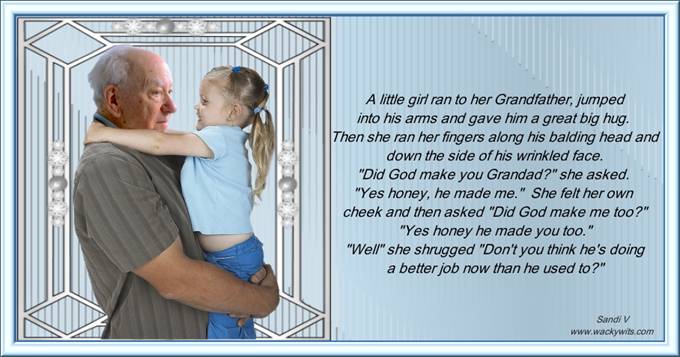
It is not how old you are, but how you are old. –Jules Renard, writer (1864-1910)

20 Saturday Apr 2013
Posted in Daily Humour
It is not how old you are, but how you are old. –Jules Renard, writer (1864-1910)
20 Saturday Apr 2013
Posted in Articles & Reports
 Concerns have been raised again in the Cuvu draft constitution session by a Fiji National Provident Fund pensioner why their pension rates have been cut as part of the FNPF reform.
The Cuvu resident asked Attorney General Aiyaz Sayed-Khaiyum why this is being done to the retired persons.
Sayed-Khaiyum said in the late 1980s and 1990s, experts recommended to review FNPF pension rates which was as high as 25 percent.
However, nothing was done.
The Attorney General said the review of the pension rates was absolutely necessary.
He had earlier stressed that the FNPF decree cannot be challenged in court however the next parliament can decide to amend or repeal the decree if they do not agree with the reform.
He said that decision will depend on the next parliament.
JUSTICE DELAYED IS JUSTICE DENIED.
Sayed-Khaiyum SHOULD BE REPLACED AS MINISTER FOR JUSTICE AND NEVER PERMITTED TO HOLD THE POSITION AGAIN
PENSIONERS SHOULD NOT VOTE FOR THIS MAN IN THE 2014 ELECTION, THEY SHOULD ALSO THINK TWICE BEFORE VOTING FOR ANY PARTY THAT SUPPORTS HIM
19 Friday Apr 2013
Posted in Articles & Reports

Minister do the children of Fiji a BIG FAVOUR, click on the following link and play Look & Learn for a few minutes
17 Wednesday Apr 2013
Posted in Articles & Reports
 Fiji government must open up constitution process if it wants to achieve truly inclusive democracy, says Minority Rights Group International
 Click on the following link to see full report:
http://www.minorityrights.org/11850/reports/fiji-the-challenges-and-opportunities-of-diversity.html
17 Wednesday Apr 2013
Posted in Articles & Reports
 Is it any wonder that many of the innocent and anguished pensioners, who are being so ruthlessly selected for a reduction in income by the Fiji National Provident Fund, no longer trust the Fund? They have lost confidence and trust in the FNPF Board chair, Ajith Kodagoda, and his fellow trustees Tom Rickets, Sashi Singh, Taito Waqa and Tevita Kuruvakadua.
These five must bear the very heavy burden of responsibility for the injustice the FNPF is now imposing on many of its middle and working class members.
The FNPF representative who has attracted most of the anger and despair of the pensioners is chief executive Aisake Taito.
Mr Taito, as the public face and voice of the FNPF, is a catastrophe. His performances at meetings with the FNPF victims were marked by obvious impatience, evasions and arrogance. He contemptuously dismissed or ignored difficult questions and had the hide to remind frightened pensioners that they should not be “personal” about the FNPF’s plans.
Personal? For God’s sake, of course it’s personal when your very own pension fund, that had promised your pension rate was for life, is getting ready to shaft you. The shafting process goes right to the core of an elderly person’s life. In their autumn years their retirement plans, founded on their FNPF irrevocable pensions, are thrown into upheaval.
They face an immediate drop in their standard of living; it is harder for them to put food on the table, pay the bills, meet their medical expenses and their family responsibilities. Those who have obligations to banks and other financial institutions based on their fixed and legally binding lifetime pensions, have been betrayed in a most cruel way.
When a despairing casualty told Mr Taito that he might now lose his home and that the Fund was “ruining our lives” the FNPF CEO appeared unmoved and unimpressed. He showed not a shred of compassion. The complainant was merely told not to make the issue personal. Those in the audience heard this with disbelief. What sort of man was this?

When Mr Taito indicated in a media interview that the FNPF is enforcing its pension cuts from a position of strength, he completed the transformation of the Fund into a callous and pitiless bully.
To the hapless victims the message is clear: ‘We are strong, you are weak. So we will do what we like because we can.’
This FNPF strength Mr Taito refers to must also mean that the fund is quite capable of honouring its contracts with its members if it so wishes.
But it does not wish to. The FNPF was always going to slash the payments of those it had in its sights. Put another way it was ready and willing to default on its obligations. For make no mistake, what we are witnessing here is a default. The FNPF is brazenly failing to meet a financial obligation. No shame, no regrets and hang the consequences.
It has obligations to the pensioners who entered into irrevocable contracts with it. Those contracts could not be changed. Even the FNPF has said this. In a statement earlier this year it emphasised that pensions were paid out monthly for as long as a member lived.
It is instructive and enlightening that, when pension rates were changed previously, current contracts were honoured.
Messrs Kodagoda, Rickets, Singh, Waqa and Kuruvakadua should reflect deeply on this. So should Mr Taito. They should not just reflect. They should examine their consciences.
Mr James Raman, a reputable citizen and former FNPF trustee, states emphatically that during his time the Board made sure that whatever decisions were taken were in compliance with trustee obligations and in accordance with the laws.
He adds: “Furthermore, the question of annuity paid to existing pensioners did not arise as it was a non-issue since pensions were paid under a legally binding contract entered (into) between the FNPF and the pensioner. To do otherwise would have been illegal. The present board should take note of this.”
Messrs Kodagoda, Rickets, Singh, Waqa, Kuruvakadua and Taito have gone into a state of deep and deadly denial on this issue of contracts. It is deadly because of the harm it is doing to their pensioners.
Mr Taito, meanwhile, is asserting that the FNPF is acting within the law because the Solicitor General says so! The CEO appears to be refuting the existence of contracts.
But he has been unable to explain why Shauna Tomkins and Stephen Mason of the Promontory Financial Group, consultants to the fund, acknowledged the FNPF did have contracts with its pensioners. Mr Mason in particular should know about this. He was a special counsel with a major Australian law firm, a member of the Australian Law Reform Commission, and had worked as a parliamentary counsel.
In a report, Promontory makes at least five references to contracts FNPF has with pensioners. It talks of contract law and contracted rate – meaning the rate at which a pension is contracted. Promontory said there would be difficulty under contract law in adjusting current pensions and it assumed they would not be changed. It says sufficient funds should be set aside to ensure future payments at the “contracted rate” were met. Promontory found little support for withdrawing existing pensions, “capping” them or resetting them.
So the FNPF board now has an unavoidable duty to explain why it tossed aside this expert advice from its own consultants.
The answer must surely be that it was dead set on trashing its pensioner contracts come what may. But we need to know why it was so fixated on doing this? From where did this obsession come?
The FNPF has now decided on its unjust and cruel course of action.
But many questions and issues remain. They will not go away now, or in the future. They will haunt the Fund and the current trustees.
If the FNPF is so certain that it does not have contractual obligations, why is it afraid to confront that question in court? Why is it a party to an iniquitous decree that robs its own members of a fundamental legal right? When Mr Taito speaks of acting from a position of strength, is he referring to the savage force of the decree?
Are the FNPF trustees prepared to go down in history as the perpetrators of the Great Contract Smashing? Are they ready to take responsibility for making Fiji into a land of broken contracts?
They know very well that observance of the law of contracts is vital for creating and maintaining commercial, investment and community confidence. The businessmen among them have an especially keen understanding of this.
If the law governing contracts is broken, an economy is damaged and investors shy away. Without investment an economy cannot produce enough jobs.
If the FNPF – Fiji’s largest financial institution – has dumped contracts once, what is there to stop it doing so again? Why should members ever trust the FNPF?
Messrs Kodagoda, Rickets, Singh, Waqa, Kuruvakadua and Taito: Hear this. Our struggle continues against all your power and strength. It will end when we have the justice to which we are entitled.
15 Monday Apr 2013
Posted in Letters
 Attorney General & Minister for Justice
Hon: Aiyaz Sayed-Khaiyum
Fax 3310807
The Facts
1 The FNPF is currently withholding $154,440 net of interest, of my money. (saved over a period of 20+ years which should have accrued interest)
2 My current FNPF pension payment is $3.34 per month or $40.08 per annum
3. I would have to live in excess of another 3,600 years to exhaust my monies currently held by FNPF, since I am in my 79th year now, the odds of that seems rather short.
4. I have asked the FNPF to refund/return the money and have had no response.
5. You as the Attorney General and Minister for Justice introduced a decree that permitted FNPF to breach basic contractual laws. Notwithstanding that, at the time of your decree these monies were part of a contract that the FNPF had not fulfilled, hence they should be returned to me.
6. We requested you to investigate this matter, but at the time of writing we have had no response from you.
7. We again seek justice from you in your capacity as Minister for Justice, and suggest the following compromise.
These monies that were paid to the FNPF in order that my wife should receive a pension after my death, should now refunded in full and be put into a trust fund controlled by a bank (not the FNPF) to be paid to my wife upon my death. Taxes to be paid to the Government on any interest earned.
It would be a sad day for the people of Fiji, if you now applied all your legal skills to defraud my wife of a pension that has already been paid for.
I await your response
Sincerely
R T Rickman
13 Saturday Apr 2013
Posted in Daily Humour
 The reason Politicians try so hard to get re-elected is that they would “hate” to have to make a living under the laws they have passed.
AND.…They cannot survive on a FNPF Degraded Pension
12 Friday Apr 2013
Posted in Articles & Reports
Decrees cannot be legally challenged according to the draft constitution
Decrees like the ones in relation to the Fiji National Provident Fund reform cannot be legally challenged according to the draft constitution however the decrees can be amended or removed altogether by the next parliament.
Questions were raised by FNPF pensioner Rick Rickman in the draft constitution consultation session in Lautoka on why the FNPF decree cannot be challenged.
Rickman said he and other pensioners entered into a legal contract and their pension has been cut under the reform.
Attorney General Aiyaz Sayed-Khaiyum said while the decrees can be reviewed or changed by the next parliament, people should understand that the FNPF reforms were necessary.
Sayed-Khaiyum said FNPF is not in existence to only pay pensions for the current pensioners but it is a long term fund.
He did not say how or at what rate of interest the government is repaying the almost 2.9 BILLION dollars it owes the pension fund.
11 Thursday Apr 2013
Posted in Letters
 I had the misfortune to listen to a religious broadcast by a Shaykh Anwar Sahib AlMadani which was apparently played by FBCL on Easter morning. People can listen to the mullah on u-tube.
His sermon, (more aptly described as a ‘diatribe’), would be objectionable enough in its contents alone- because why anyone would want to bother linking only Easter with paganism, as this mullah did, when it is common knowledge that every monotheistic religion, including his own, has its roots in paganism, is beyond me. I was shocked by such a conservative, and rabid, expression of Islam coming from a cult-like section of the religion which some people in Fiji are clearly into.
In addition, why would anyone actually pay for such a nonsense expression of a religion? And why would FBCL even broadcast it? These are questions the Fiji government just has to take up with FBCL.
However, what is really appalling is that FBCL (a public broadcast entity funded by the public purse) chose not only to broadcast a religious rant when the Prime Minister has already declared Fiji to be a secular state, but also to do so on Easter Sunday. No wonder it is identified as a deliberately provocative act on the part of FBCL which is rather more closely aligned with the Fijian state than it should be as a media outlet. Even more seriously, this broadcast was made in violation of section 17 (3) (d) of the Government’s draft Constitution 2013. The Fiji Human Rights Commission should take this matter up as its ‘own motion’ investigation.
Frankly, there should be no religious broadcasts whatsoever on public radio. Religion is a private matter between a person and his or her God. No one should be confronted with any form of proselytising from anyone. We had enough of that before 2006. Public radio, which everyone pays for and listens to for news and entertainment, is certainly not a proper forum for religious postering and preening.
If the Government says Fiji is a secular state, as PM Bainimarama has been promoting recently, it should start educating its own public radio the FBCL, which it funds far too handsomely from the public pocket in my view, that it cannot bring its leadership into disrepute by these sorts of broadcasts. There are occasions when such mistakes cannot be cured just by an apology.
Dr Shaista Shameem
11 Thursday Apr 2013


