Diabolical Decrees

COONEY RADIO AUSTRALIA: Does this concern you and the whole process towards elections in 2014? 

GHAI ANSWERED : Well it does because another position they have removed is our examination of existing laws for possible incompatibility with the draft constitution

And there are hundreds of decrees past since the coup which have stripped the rights of access to courts, media is under pressure subject to heavy penalties, trade union rights have basically been removed, civil servants have no protection. 

And it seemed to us that a lot of these decrees needed to be amended and in some cases repealed

“Now that power has been taken away from us, and I do not see how Fiji is going to have a free and fair election unless these decrees are cleaned up. So that power has been taken away and it’s extremely worrying. 
  
“This change was brought out last week in the last month of our process, we have spent a lot of time, effort and money into examining all the decrees and the proposals for change, and at this last stage we are told that is not our responsibility.” 

LET’S FACE THE TRUTH FRANK. YOUR GOVERNMENT HAS CRIPPLED THE RIGHTS OF ORDINARY PEOPLE TO SEEK RECOURSE THROUGH THE COURTS, PARTICULARLY PENSIONERS. 

WHAT YOU AND YOUR BOY DO NOT SEEM TO UNDERSTAND IS THAT GENUINE INVESTORS NEED TO SEE A FAIR AND JUST LEGAL SYSTEM IN PLACE IN A COUNTRY BEFORE THEY WILL INVEST. 

NO DOUBT YOU WILL STILL GET THE POLITICAL ARSE KISSING CARPET BAGGER INVESTORS WITH NO MONEY WHO RELY ON THE FNPF TO FUND THEIR SCHEMES AND THEIR OFFSHORE ACCOUNTS. 

YOUR DECREES OF CONVENIENCE ARE JUST THAT, THEY ARE NOT SUSTAINABLE LAWS AND THAT IS WHY YOU AND YOUR BOY ARE AFRAID TO HAVE THEM EXAMINED AND REVIEWED.

A DECREE THAT DEPRIVES PENSIONERS OF THEIR CIVIL RIGHTS CAN NEVER BE A SUSTAINABLE LAW. 


Good Friends

Two 81 year old men, Mike and Joe, have been friends all of their lives.
  
When it’s clear that Joe is dying, Mike visits him every day. 
  
One day Mike says, “Joe, we both loved football all our lives, and we played football on Saturdays together for so many years. Please do me one favour, when you get to Heaven, somehow you must let me know if there’s football there.” 
  
Joe looks up at Mike from his death bed,” Mike, you’ve been my best friend for many years. If it’s at all possible, I’ll do this favour for you. Shortly after that, Joe sadly passes on. 
  
At midnight a couple of nights later, Mike is awakened from a sound sleep by a blinding flash of white light and a voice calling out to 
him, “Mike–Mike.” 
  
“Who is it? asks Mike sitting up suddenly. “Who is it?” 
  
“Mike–it’s me, Joe.” 
  
“You’re not Joe. Joe just died!” 
  
“I’m telling you, it’s me, Joe,” insists the voice.” 
  
“Joe! Where are you?” 
  
“In heaven”, replies Joe. “I have some really good news and a little bad news.” 
  
“Tell me the good news first,” says Mike. 
  
“The good news,” Joe says,” is that there’s football in heaven. Better yet, all of our old friends who died before us are here, too. Better than that, we’re all young again. Better still, it’s always spring time and it never rains or snows. Our wives are there too, and young and pretty as ever! And best of all, we can play football all we want, and we never get tired!!” 
  
That’s fantastic,” says Mike. “It’s beyond my wildest dreams! So what’s the bad news? 
  
“You’re in the team for this Saturday”. 
  

ENTITLEMENT?

(A RE-WRITTEN FORWARDED EMAIL FROM THE U.K.)

 I paid good money for my Pension and other benefits. Just because the Government borrowed that money does not make my benefits some kind of charity or hand-out. Gold plated MP pensions, and Civil Service Government benefits also known as ‘health care’, 67 paid holidays, 20 weeks paid vacation, unlimited paid sick days: now that is welfare. And they have the nerve to call me a ‘greedy pensioner’ and my retirement an ‘entitlement! What is wrong with all the people who run this country? Wake up Britain!

 We’re ‘broke’ and can’t help our own pensioners, orphans and homeless etcetera; but spend billions of pounds on G2 events! In the last few months we have provided aid to IndiaGreece andTurkey. And now Afghanistan and Pakistan – the home of bin Laden. Literally, billions of pounds.

 Our retirees, living on a ‘fixed income’ receive no aid, nor do they get any breaks – while our government and religious organisations pour hundreds of billions and tonnes of food into foreign countries.

 They call Old Age Security and Healthcare an ‘entitlement’ even though most of us have paid for it all our working lives. And now – when it is time for us to collect, the government is running out of money. Why did the government borrow from it in the first place?

 We have hundreds of adoptable children who are shoved aside to make room for the adoption of foreign orphans. This is Great Britain: a place where we have homeless without shelter; children going to bed hungry; and hospitals being closed.

 Britain’s average income families cannot afford dental care. The elderly go without needed medication and have to travel hundreds of miles for necessary medical care with no reimbursement of cost, have vehicles we cannot afford the fuel for. There is a lack of affordable housing. The mentally ill go without treatment.

 Yet! There is a ‘benefit’ for the people of foreign countries with ships and planes lining up for food, water, tents, clothes, bedding, doctors and medical supplies to transport overseas.

 Imagine if the Government gave ‘us’ the same support that it gives to other countries! Sad – isn’t it?

 A pension is not an ‘entitlement’ – that’s a handout. We worked for our pensions: and we worked secure in the knowledge that we were providing for our old age with our own money. Then the government stole it – simple as that.
So tell us Frank, does it make you feel proud that yours is not the only government stealing from Pensioners ??


What about Our Ministers

THE Australian Prime Minister, Julia Gillard, is more than three months overdue in declaring to Parliament gifts and hospitality amassed as spoils of the top job.

( Has anyone seen a declaration by Fiji’s top Ministers ?)

Parliament’s all-important pecuniary interests register, which requires MPs and senators to publicly report all gifts of more than $300 from private sources or more than $750 from foreign dignitaries within 28 days, reveals Ms Gillard has not updated her file since June 16.

Ms Gillard has provided only two updates to the register this year, a significant shortfall on the previous year when the Prime Minister detailed gifts presented by various dignitaries on 17 occasions.

The failure to complete paperwork on time includes Ms Gillard yet to declare tickets provided by the AFL for the grand final in September, with the hospitality confirmed by a separate register kept by the Department of the Prime Minister and Cabinet.

The former Labor, now independent MP Craig Thomson was plunged into controversy when he failed to disclose that the NSW Labor Party had paid $90,000 of his legal fees.

Grilled on the matter in question time in August last year by the Liberal frontbencher Christopher Pyne, Ms Gillard said: ”Of course, there is an obligation on all members of the Parliament to abide by the rules in relation to declarations of interest.”

She added, during the height of the scandal relating to Mr Thomson’s use of credit cards when he was a Health Services Union official: ”As the member who asked the question would well know, there is more than one member in this Parliament that has declared things late. Of course, people should abide by the rules.”

Read more: http://www.smh.com.au/opinion/political-news/gillard-fails-to-declare-gifts-received-since-june-20121103-28qvg.html#ixzz2BBdSorC6

The Letter Croz Walsh will not publish on his Blog

Dear Croz,

I refer to your commentary on James Anthony’s note to the Constitutional Commission and would like to make a few observations which I hope you will publish on your website: ( Croz did not , so we are)

First of all, a correction – Dr James Anthony is not Felix Anthony’s brother. They may be vaguely related by marriage but there is no actual relationship otherwise. In fact, perish that thought!

Secondly, I myself attended that conference to launch the Pacific Studies Centre at Auckland University 26 or more years ago, to which you referred in your commentary. I had not previously met Dr Jim Anthony and was very interested to hear him speak. He was an icon for many because he had successfully challenged the hegemony of colonialism and capitalism in Fiji in 1959, and was something of a ‘Ned Kelly’ figure. Not many Europeans in colonial Fiji liked Jim precisely because of that, and instead of getting a job at USP, lecturing us (local) students- as he should have done after he earned his PhD, Jim’s application was turned down by none other than the VC at the time, Colin Aikman. Jim certainly would have made a huge difference to our learning because of his unique perspective on Fiji, the Pacific and the world; instead, those of us who attended that university ended up learning about our societies from the colonial perspective- something that Bainimarama, for all his other faults, now rightly condemns as the Australian and New Zealand viewpoint in interviews with Graham Davis and the like. 

But getting back to the Auckland conference, I don’t remember the Maori ‘extremists’ as you call them hijacking the conference as you do. I do recall that some very strong views were expressed about colonial attitudes towards Maori and Pacific Islanders similar to what we had experienced in Fiji. We were ready for that challenging perspective since many felt that even the Pacific Studies programme at Auckland University had been captured by the lavalava-wearing colonial academics who exploited Pacific Island people for their intellectual property. 

Anyway Jim was always defined as an ‘Indian’ (whether he appreciated it or not) so he would have been seen as part of the non- Pacifika group at that conference, and probably also left that session that you referred to. Your recollection of Vijay Naidu being ‘adopted’ by Epeli Hau’ofa though is correct, and Vijay was indeed in that ‘privileged’ position. But young though I was at the time, I found such gestures of patronage to be distasteful- if the Pacific Islanders like Epeli Hau’ofa -a kind man- had to adopt Indo-Fijians as ‘Pacific Islanders’ instead of leaving the room and standing in solidarity with them, this was a sorry saga indeed. Such an assimilationist strategy was even then considered to be objectionable and a violation of international human rights law. Assimilation was imposed on the Maori by Pakeha and we all know the consequences of that on the tax-payer in NZ; the courts have made everyone pay for that colonial insult. I recall that Vijay Naidu stayed because of that ‘adoption’; I was glad to leave the room because the problem was not Indians, as they were not the focus of the Maori ‘extremists’ as you call them (freedom fighters by another term), but the Pakeha at that conference who chose to define what Pacific Studies was all about, and a lot more can be said about that, as you know. 

Jim is no longer an academic as such, since he has now retired, but he is an intellectual and there is a huge difference between the two. Academics remain at universities – intellectuals survive them! Jim still has a lot to offer and is a son of Fiji, better than most. He has a right to comment on what goes on there, as much as anyone else- particularly on the latest developments in the Constitutional Commission- without being the target of a personal attack based on erroneous facts as you have done from the advantageous position of your own blogsite. 

The Constitutional Commission of Fiji made an unpopular decision, judging from the media reports, to have a person like Ratu Joni Madraiwiwi appointed as a consultant when he came to a public hearing in support of a group that formally espoused racist views (to call for a Christian State in Fiji is racist whether or not you can appreciate the nexus between ethnicity and religion in our context). This starkly shows that the Commission is acting ultra vires the terms of reference given to it under section 3 of both Decrees No 57 and 58, notwithstanding the gloss and obfuscation that you and your columnist Alan Lockington, and indeed the Commission, are trying to put on this appointment. No one heard even a whisper of a dissenting opinion on the idea of a Christian State from anyone within that group making those submissions to the Commission and Ratu Joni’s presence there had a chilling effect on the minority ethnic groups. Unless the Commission is operating on another planet or some parallel universe, surely it should find the public opinion somewhat revealing? That kind of complete disjunction from reality is what makes many people agree with the main political parties and trade unions of Fiji (the ‘constituent assembly’ in fact) which, in the unprecedented move of a joint statement, essentially called for the disbanding of the Commission. With such heartfelt collaboration among the main body-politic on some issues perhaps consensus can be reached on others as well, thus obviating the need for former political divisions, and indeed for a Constitutional Commission. The political parties can organize constitutional review themselves and, with goodwill, sort out a new constitution for Fiji. It will certainly save time and money. As a tax payer of Fiji whose taxes are likely helping to pay for the salaries of the Commission and consultants, I must say that it is difficult not to agree with the critical viewpoint. 

Jim Anthony’s statement to the Chair of the Commission puts it rather nicely in my view. He was never known to mince his words in his youth- why should he start now? In a few short, pithy sentences he expressed the sentiments of many in Fiji by holding the now one-sided process of constitution-making up for critical scrutiny. 

Dr Shaista Shameem

Auckland. 30-10-2012

Fiji’s paramount chiefs, political parties and unions petition President for a caretaker government

HE Ratu Epeli Nailatikau LVO, OBE,CSM,MSD,OStJ, jssc,psc
President
Republic of Fiji
Government House
Suva

Your Excellency

re: Proposed constitutional process and
Fiji’s return to democratic rule

We, the legitimate representatives of an overwhelming majority of the people of Fiji, write to you to express our anxiety at the manner in which the proposed constitutional process and the return to democratic rule via general elections is being driven by the current administration.

First and foremost, Sir, it is imperative to ensure the credibility and legitimacy of any roadmap that is adopted to return our nation to constitutional rule.The roadmap proposed by the interim Prime Minister does not meet this important requirement. Further, we are concerned that it has been unilaterally imposed on the people of Fiji without any consultation with the legitimate representatives of the people.

In our view, the legitimate way forward for the country is to abide by the decision of the Fiji Court of Appeal judgment of 9 April 2009. As advised in the judgment, a caretaker cabinet should be appointed with the specific mandate to oversee the process of holding general elections and restoring constitutional rule within a realistic time frame.

The Constitution Making Process 
Firstly, members of the Constitutional Commission were appointed by the regime without any consultation with key stakeholders. There are serious reservations about the independence of certain members of the Commission who are perceived by the people to be too close to the current administration.

Secondly, the restrictive environment in which the constitutional process is taking place, will not encourage free and open discussions on the subject. Draconian decrees that suspend and violate human rights especially the right to freedom of expression, assembly and association, remain in force as instruments of fear and intimidation. The local media is still operating under constraints that undermine its freedom to disseminate news fairly and in a balanced manner without fear of repercussions from the regime.

There are credible reports of a certain media organization being threatened by the interim Attorney General following its interviews of two prominent leaders of political parties.

A State sponsored civic education programme on constitution making has begun but key stakeholders, such as, political parties, trade unions and other important civil society organisations have been excluded from participating and/or playing an active role in this exercise.

It is also a matter of grave concern that military officers and civil servants are assigned to head the civic education programme.

Moreover, threats by the RFMF warning people not to “mess with the Army” make a mockery of the initial assurances by the interim Prime Minister that people will be free to openly state their views on the proposed constitution.

The requirement that political parties and trade unions seek separate permits for each consultation/discussion meeting has now been relaxed  but political leaders and party activists are still being closely monitored and harassed by the security forces.

We re-iterate, no meaningful dialogue or consultations can take place in such a restrictive climate. In short the process is not inclusive or participatory and it lacks credibility and legitimacy.

Thirdly, the composition of the Constituent Assembly which according to the interim Prime Minister’s statement of March 9 will finally decide the constitution, has not been fully disclosed. There is widespread concern that it may be stacked to ensure a particular outcome. The Prime Minister has full control over appointments to the Assembly. This, in itself, undermines its independence and integrity.

We note with some concern a recent government announcement that chair persons of provincial councils will, from this year, be appointed by the Minister and not elected by members of the respective councils as had been the case in the past. There is little doubt, judging from past practice in such matters, that provincial councils will be invited to be members of the constituent assembly.

Furthermore, why are appointments to the Constituent Assembly put back to December 2012, just days before it is to begin its deliberations? Why has there not been any consultation on the subject?

The Role of the Military
There is one significant omission from the interim Prime Minister’s list of essentials that must be written into any new constitution. We refer to the role of the military in any future governance of Fiji. We note the reluctance of the regime to permit free and full discussions on the role of the military.

Whether the constitution is re-written or not, the role of the military has to be thoroughly considered and finalized once and for all. The Army has been responsible for trashing our constitution thrice. Fiji has to ensure this does not happen again otherwise the nation could be treading the same path again and again in the future.

The Electoral System
The interim Prime Minister says the subject of an electoral system is non-negotiable. The regime’s position here is for proportional representation based on one man, one vote, one value. We disagree. This is a crucial issue in ensuring racial harmony and political stability in the future and must be put to open discussions so that a fully representative system which respects the rights of the minority communities can be found.

The significance of reserved seats for different ethnic communities that make up the nation cannot be brushed aside in a multi-ethnic and multicultural country like ours, more so, in light of our political history.

The Electoral Process

There is much that is questionable about the manner in which the electoral process is being implemented. The Attorney General’s office has taken charge of the voter registration process when it should be the responsibility of the Office of the Supervisor of Elections. In the interest of credibility, it is vital that the entire electoral process, including that of voter registration, be completely detached from the current administration.

The provisions of the Electoral Act and Regulations were arbitrarily amended by a Decree to assign this responsibility to the Attorney General’s office. The chair of the Constitutional Commission has also been critical of the interim regime assuming charge of the electoral process, saying that it undermines the integrity of the process as it is likely that some members of the current administration may be competing in the forthcoming elections.

The following appointments are essential to oversee the entire electoral process, independent of the regime and political parties:

Electoral Commission
Boundaries Commission
Supervisor of Elections

In the absence of a Constitutional Offices Commission (1997 Constitution), these appointments should be made by the President  on the advice of a caretaker administration(see Para 24) after due consultations with key stakeholders.

The promulgation of Decrees 57 and 58 undermine the independence, integrity and credibility of the process. The provisions therein relating to the grant of immunity from prosecution to the perpetrators of the 2006, 2000 and 1987 coups and the absolute powers of appointment of the Constituent Assembly conferred on the interim Prime Minister, make a mockery of the entire constitutional process.

It is significant that the Chair and members of the Constitutional Commission have said that as much and we quote below from the media release issued by the Commission on 19 July 2012:

“Nonetheless there are a number of aspects of the Decrees about which we are concerned.

First, although the Constituent Assembly Decree lists some of the groups that will be represented in the CA (such as political parties, trade unions, women, the military, and civil society etc.), it gives the Prime Minister full control over the size and composition of the Constituent Assembly. There is no indication of how many members will be drawn from each sector or what other sectors might be included. There is also no provision giving the groups that are represented a say in who should represent them in the Assembly. The Prime Minister will also appoint the Speaker of the Assembly.

These arrangements effectively mean that the essential principles of democracy are ignored and the independence of the Assembly is negated. In the light of the fact that members of the present government may wish to compete in the forthcoming elections, it is particularly important that they should not control the process that will, among other things, set out the rules for the elections. This will undermine the credibility of those elections.

Secondly, the Decrees require a broad immunity provision for the 2006 and earlier coups to be entrenched in the new constitution. Among other things, the new constitution is to grant the same, broad immunity for actions up to the first meeting of a new Parliament to members of the government, administration and security forces as was granted by decree in 2010. This type of prospective immunity is most unusual, perhaps unique, and, we believe, undesirable. The only exception is that the new constitution is not required to give immunity for common crimes (such as murder and assault) committed after the date of issue of these Decrees.

The Commission recognizes that immunity has been given in the past and that the immunity required in the new constitution is similar to those immunities and it also understands that the issue of immunity must be considered in the process of transitioning to democracy. However, we are concerned that the people of Fiji have not been consulted in any way on this important matter.

We believe that a better approach would be for the question of immunity to be part of the constitution-making process. If immunity was part of the process, it could be discussed through submissions to the Commission and debate in the Constituent Assembly. Then a solution could be reached that citizens believe would promote the transition to democracy and contribute to a sustained democracy as envisaged in the Preamble to the Decrees.

Thirdly, although the temporary suspension of the requirement of permits for meetings is an important step forward, we are concerned that the current atmosphere in Fiji is not conducive to an open process in which Fijians can debate their future properly. Controls over the media and the wide reaching powers of the security forces in this regard are particularly worrying, as is the fact that generally people have no redress for actions taken against them by the state because the right of access to the courts has been removed.

An important part of the process for the constitution making should be the bringing together of all the people of Fiji to discuss freely, and agree on, the future of their country. It should be an occasion for national reconciliation, acknowledging the violation of human rights and other abuses of power, and to commit the nation to a vision of Fiji based on democracy and respect for human rights, and a determination to overcome the divisions of the past. This task requires the full participation of the people in the process, and the freedom of their representatives in the Constituent Assembly to negotiate a settlement that enjoys wide support in the nation.”

These comments must not be taken lightly. Indeed, they make a highly cogent case for not proceeding with the constitution making exercise as fashioned by Decrees 57 and 58 to which Your Excellency, most regrettably, gave his assent. The Commission clearly recognizes that the process is being controlled by the interim administration to protect their own interest. In the event we urge Your Excellency to consider the alternative which we outline hereunder:

The Legitimate Way Forward
In our view, the only legitimate course of action that should be followed to return to the rule of law and constitutional rule, is to revert to the Fiji Court of Appeal judgment of 9 April 2009 (Qarase vs Bainimarama-Civil Appeal No ABU 0077 of 2008s).

The Appeals Court had found that the dismissal of the SDL government and the dissolution of Parliament were unlawful and in breach of the Fiji Constitution; and that the 1997 Constitution was still in force and had not been abrogated. It further held that the appointments of the Army Commander, as Prime Minister, and that of his ministers were not validly made.

In acknowledgement of the realities of the situation, however, namely, that a defacto government had been in office for the past two years, (in paragraph 156 of the judgment)their Lordships held that:

“The only appropriate course at the present time is for elections to be held that enable Fiji to get a fresh start.

Taking cognizance of the principle of necessity… for the purposes of these proceedings, it is advisable for the President to appoint a distinguished person independent of the parties in litigation as caretaker prime minister to advice dissolution of Parliament and direct the issuance of writs for an election under s60 of the Fiji Constitution. This is to enable Fiji to be restored to constitutional rule in accordance with the Constitution.”

Your Excellency, we hold that the course of action advised in the judgment should be followed. A caretaker administration should be appointed with the specific mandate to oversee the process of holding general elections and restoring constitutional rule, within a realistic time frame. This should be no longer than 12 months as we deem it is possible to hold credible elections within that period.

We, respectfully, propose that Your Excellency give serious   consideration to act on the advice rendered in the Fiji Court of Appeal decision to appoint a caretaker Prime Minister – a distinguished person, independent of the political parties and the regime and one in whom our people can repose confidence – to advice dissolution of Parliament and direct the issuance of writs for an election under Section 60 of the Fiji Constitution.

The caretaker administration should then assume full responsibility for the constitutional and electoral process.

A President’s Political Dialogue Forum (PPDF) can be established following the appointment of the caretaker administration. The mission of the PPDF would be to assist the caretaker government in obtaining   consensus on the roadmap for the restoration of constitutional government via free, fair and credible general elections.

Our feedback from the people is that there is overwhelming support for the 1997 Constitution to be retained. Any changes to it can be discussed and agreed to in the PPDF. The constitutional Commission can be tasked to write a draft national charter using the 1997 Constitution as the base (reference) document. There is no need to rewrite the entire constitution as the 1997 Constitution was promulgated after wide consultations with the people.

Your Excellency, Fiji no longer has the luxury of time on its side. Conditions have deteriorated considerably in the past five years and our people are being held to ransom while those in authority abuse the power that they have usurped.

The President’s mandate to the interim administration given in January 2007, remains unfulfilled. There has been constant rhetoric from the regime that it will spend the first three years (2009 to 2012) on “reforms” such as rebuilding the economy and fixing up the infrastructure. To date, there is little to show for it. The economy continues to be in recession and much of our infrastructure has deteriorated considerably, both in the urban and rural areas.

State finances are more precarious now than they were in 2006; the national debt crisis has deepened with State borrowings having risen sharply in the past three years. We are now borrowing new money to repay old debts.

Poverty levels have escalated with at least 40% of the population living in absolute poverty according to credible sources – indicative of the hardship facing our people. Business confidence is so low that private investment levels sank to a worrying 2% of the GDP last year. 

FNPF’s decision to cut pension rates down to 8.7% from the current rates ranging from 25% to 15%, will cause severe hardship to many of the nation’s elderly. It is a worry even for future pensioners considering that some 60% of Fiji’s workers receive wages that are below the poverty line. In a country where there is no social security net, the majority of Fiji’s senior citizens will no longer be able to retire in dignity and on a livable pension.  

Key sectors of the economy are deeply troubled. The sugar industry is in a highly critical state with sugar production virtually halved, down from 330,000 tonnes in 2006 to 165,000 tonnes in 2011. The Fiji Sugar Corporation is insolvent, surviving on borrowed funds and government grants.

The Corporation registered a loss of $37m for the 2011 financial year, its total borrowings stand at $218m and it faced debt repayment commitments of $113m for the year ending 31 May 2012 which it was unable to meet, according to the 2011 report of the independent auditors of FSC.

Air Pacific is similarly placed with heavy financial losses -$92million  sustained in the 2010 financial year, reduced to a $3.6m ‘book’loss last year. But the actual loss is believed to be much higher. Recent announcement of a$11m profit last financial year is viewed with a great deal of scepticism by financial experts in the absence of published audited accounts of the airline.  

Other troubled public entities are: FNPF, PAFCO, Hardwood Corporation, Telecom Fiji, Post Fiji and Tropik Woods. 

Official corruption is rife and there is no accountability or transparency in government’s dealings. Government accounts and the Auditor General’s reports have not been published for public scrutiny since 2008. It is significant that Transparency International gave Fiji zero out of 100 points in a survey about budget transparency in 2010, saying it is “virtually impossible for Fiji citizens to hold its government accountable for its management of the public’s money”.

The Asian Development Bank in its latest economic survey, Outlook 2012 released in April has warned that unless the debt to GDP ratio is reduced significantly, there would be little scope for further fiscal expansion and the provision of public services would be adversely affected. It also warned that Fiji’s medium term macro-economic outlook was “weak and foreshadows greater poverty challenges”.

Your Excellency, urgent action is needed to stabilize State finances, revitalize the economy, restore investor confidence, and deal with the worsening social issues of poverty, unemployment, housing, health care and rising crime levels.

The current administration has been unable to demonstrate that it has either the competence or the acumen to deal with these issues. The past five years have illustrated this quite graphically. It has failed on various counts with dire consequences for our people and the future of Fiji as a viable State.

The following developments also cause a great deal of anxiety about Fiji’s future: massive outmigration of skilled people who do not see a future here influx of foreign nationals with questionable intent. There are reports linking them with drugs, prostitution and gambling rackets etc high rate of unemployment among youths the dismantling of democratic entities and traditional indigenous Fijian institutions serious violations of human rights – as cited in independent reports (Amnesty International, UN Human Rights Council, US State DepartmentReport on Human Rights, ILO Report on Trade Union rights – ILO Case No. 2723) promulgation of draconian decrees which curtail or completely deprive the workers of their rights to organize and bargain collectively – a gross violation of ILO Conventions 87 and 98 which have been ratified by Fiji interference with the independence and integrity of the judiciary is respect for the rule of law as clearly demonstrated by the promulgation of various draconian decrees that debase human rights and compromise the rule of law, including interference with due judicial processes

The entire nation is held to ransom by a small group of individuals who have usurped lawful authority for their own benefit. These same individuals continue to use the Military and the Police to remain in power.

Failure to come up with a credible roadmap to restore democratic rule in the past six years has resulted in our isolation from the international community. We have been suspended from the Commonwealth and the Pacific Islands Forum, while hundreds of millions of dollars of much needed development aid has been withheld by the European Union.

This is the stark reality about our Fiji today. Ordinary people are getting restive as they find it difficult to meet even the basic needs of their families – to put food on the table and to provide for other essentials. The rising rate of malnutrition among our children, increasing incidence of diseases such as TB, substance abuse and suicides are all indicative of the worsening poverty situation in our country.

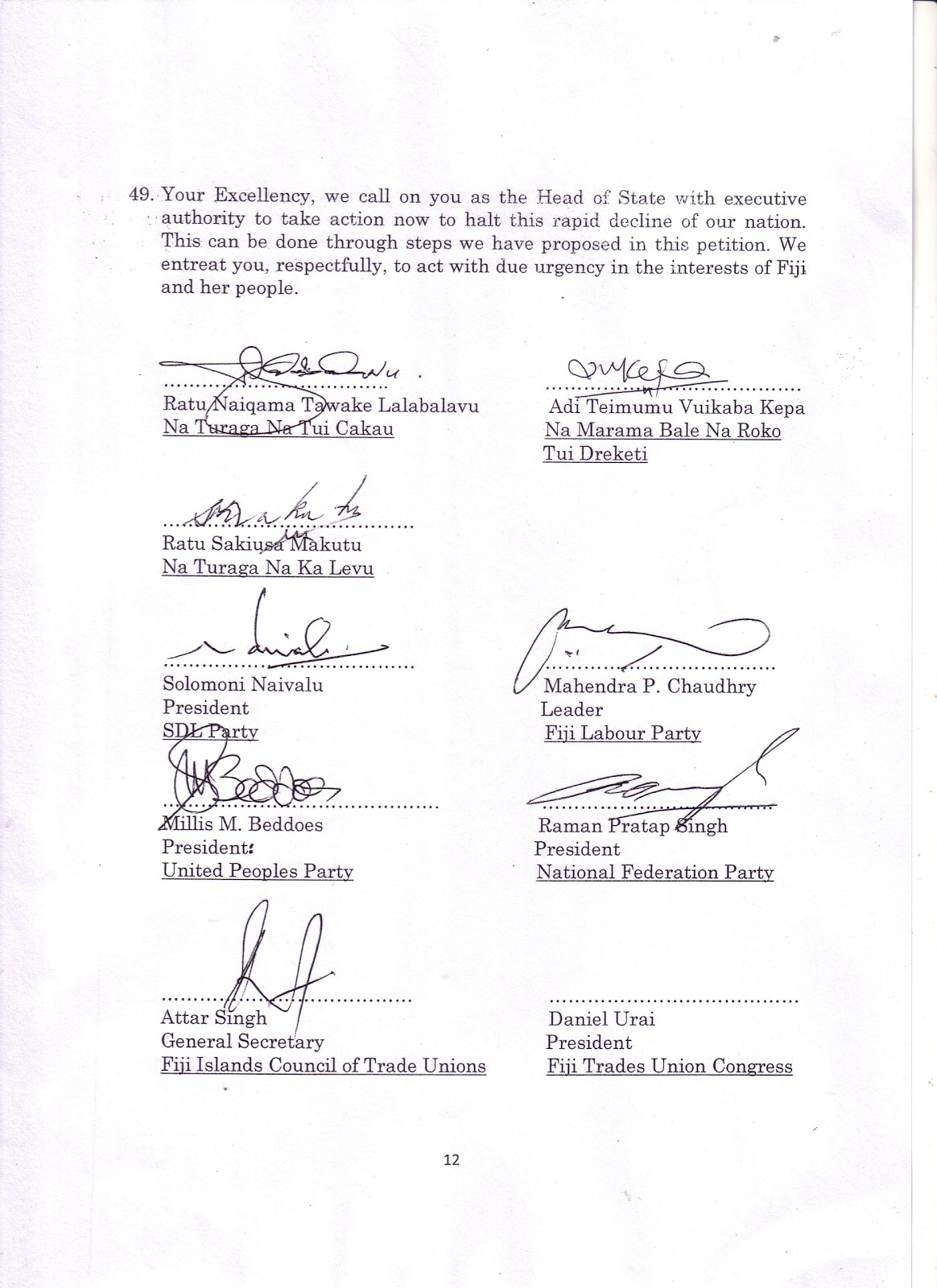
Your Excellency, we call on you as the Head of State with executive authority to take action now to halt this rapid decline of our nation. This can be done through steps we have proposed in this petition. We entreat you, respectfully, to act with due urgency in the interests of Fiji and her people.

FNPF pensioners shocked at ISSA award for FNPF (reported in Fiji Sun 27th October)

David Burness and other class action pensioners in the case of Burness v the Fiji National Provident Fund , the Republic of Fiji and the Attorney General HBC 183 of 2011 whose pensions were cut by Decree in the name of FNPF’s ‘reform’ have expressed their shock at the announcement of the International Social Security Association (ISSA) that it will present two ‘certificates of merit’ to the Fiji National Provident Fund next week.

The ISSA is a not for profit (NGO) organisation based in Geneva. The ISSA’s Constitution states that its members are government departments, institutions, agencies and other entities administering social security. ISSA provides guidelines for social security coverage internationally.

Speaking for David Burness, lawyer Dr Shaista Shameem said that the ISSA gives the impression that it is part of the International Labour Organisation because its website gives its address as the ILO in Geneva. This is misleading because people think that the Association is part of the ILO.

In March this year ISSA signed a Memorandum of Understanding (MOU) with the ILO to reinforce their collaboration to extend and support social security world wide and to strengthen coordination of both organisations for social protection. What FNPF did in Fiji was the opposite of this, Dr Shameem said.

She said it was ironic that ISSA was rewarding FNPF for its human rights breach of pensioners’ right to social security and to their right to life. David Burness’ application to court asked for remedies for a human rights violation in the form of FNPF pension cuts which affected his right to life. This right is one of the fundamental rights in the Universal Declaration of Human Rights which the International Labour Organisation is bound to up-hold, and not promote its loss, Dr Shameem said.

She said it was particularly hypocritical for ISSA to hand out this award to the FNPF when ISSA itself had insisted in the 1970s that FNPF change from a ‘savings’ to a pension’ scheme. This fact was in the documents before the court in the Burness case. The effect of this change on the FNPF was to be addressed in the court case but the FNPF pensioners were prevented by Decree from having their day in court.

Dr Shameem said that ISSA’s MOU with ILO commits the two organisations to closer programmatic and strategic cooperation. The ILO team were recently unceremoniously removed from Fiji by the Government. The ILO has also frequently objected to Fiji’s anti-labour rights record.

Mr Burness and other pensioners will be requesting the ILO to immediately take this matter up with its partner the ISSA, as a complaint.

Dr Shameem said that the pensioners felt that such undeserved awards given to the FNPF, which had acted unlawfully in breaching pensions contracts, puts the ILO on the spot. Even more so when an executive FNPF Decree went on to interfere with pensioners’ access to the courts. The right to justice is another international human rights principle of the International Labour Organisation, she said.

All supporters of pensioners should write to the Director of the ILO in Suva (David Lamott) and send him messages to forward to ILO Director General in Geneva

Get Up. Get Out. Don’t Sit.

Just as we were all settling in front of the television to watch the rugby, two new studies about the perils of sitting have spoiled our viewing pleasure.

The research, published in separate medical journals this month, adds to a growing scientific consensus that the more time someone spends sitting, especially in front of the television, the shorter and less robust his or her life may be.

To reach that conclusion, the authors of one of the studies, published in the October issue of The British Journal of Sports Medicine, turned to data from the Australian Diabetes, Obesity and Lifestyle Study, a large, continuing survey of the health habits of almost 12,000 Australian adults.

Along with questions about general health, disease status, exercise regimens, smoking, diet and so on, the survey asked respondents how many hours per day in the previous week they had spent sitting in front of the television.

Watching television is not, of course, in and of itself hazardous, unless you doze off and accidentally slip from the couch onto a hard floor. But television viewing time is a useful, if somewhat imprecise, marker of how much someone is engaging in so-called sedentary behavior.

“People can answer a question like, ‘How much time did you spend watching TV yesterday?’ much better than a question like ‘How much time did you spend sitting yesterday?’ ” says Dr. J. Lennert Veerman, a senior research fellow at the University of Queensland, who led the new study.

Australians, as it turns out, watch lots of telly. According to the survey data, in 2008, the year that the researchers chose as their benchmark, Australian adults viewed a collective 9.8 billion hours of television.

Continue reading

We are not alone

The Australian Government find another way to confiscate seniors pensions savings

The Australian budget will receive a boost of almost $900 million under a plan to transfer millions in unclaimed money to the taxman and the corporate regulator.

In a measure announced today, the government will collect an extra $675 million by lowering the threshold at which inactive superannuation accounts are automatically moved to the Australian Tax Office.

At present, super accounts of people who cannot be contacted are transferred to the tax office if they hold less than $200 and there have been no contributions for five years.

But from January, super accounts will be transferred to the ATO if the account’s owner can’t be contacted, there is less than $2000 in the fund, and there have been no contributions for one year or more.

With the nation’s lost super accounts holding about $17 billion, the change will deliver to the budget $675 million in savings over the next four years.

The unclaimed money will be held in trust by the government, but members can reclaim their lost funds from the tax office.

“These reforms will benefit individuals with small lost accounts by preventing these accounts from being eroded by fees and charges and protecting the real value of these balances,” the government’s Mid-Year Economic and Fiscal Outlook said.

Similar treatment will be applied to unclaimed bank deposits and life insurance policies, giving the government an extra $92.3 million over the next four years.

Under current rules, bank deposits can only be transferred to the Australian Securities and Investments Commission if they are inactive for seven years, but this will be cut to three years from January.

Unclaimed company money will also be automatically transferred to ASIC, delivering $118.5 million in savings over four years.

While the government expects to receive a boost from the changes, Superannuation Minister Bill Shorten said raising the threshold for unclaimed superannuation would help unite members with their retirement savings.

“The ATO will use its data matching resources to match these lost accounts with members and assist those members to be reunited with their lost superannuation,” Mr Shorten’s office said in a statement.

Under the changes, the ATO will also pay members an interest equivalent to inflation on their unclaimed super. At present, no interest is paid.

The government said the reforms would help lower the amount of unclaimed super because it would encourage super funds to collect more information about their members while the accounts were active.
Read more: http://www.smh.com.au/opinion/political-news/unclaimed-cash-to-boost-budget-by-900m-20121022-280vy.html#ixzz2A0GXroyl