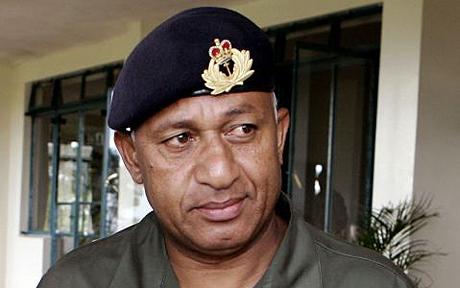
Bleak Future Prospects

ChaudhryFiji Labour Party Leader, Mahendra Chaudhry has clarified that the FLP, National Federation Party and Social Democratic and Liberal Party have agreed in principle to a post election alliance .

The major alternative at the moment is Frank and his present power grabbing Minister for Most Things.

There is a clear and present danger that voters will suffocate from the stench of cronyism in the voting booths.

Did Frank do the right thing ?

FijiTHE COMMODORE

There was an immediate cross-party negative reaction to the 2006 coup in Fiji, civilised as it was by world standards. One would gather that the government toppled was wise, dispassionate, committed to the development of Fiji, even-handed and honest. Sadly, none of this was true. The Commodore’s demands were demands that should have been made by Fiji’s donor nations and backed up with threats of withdrawal of aid years ago. His chief demands were that the Qarase government sack and prosecute ministers involved in the George Speight coup which the Commodore had thwarted; that the government tackle the massive conventional corruption endemic in the public sector; and that the government abandon the new-style corruption identified in the editorial in this Journal in November 2006 whereby the government taxes the parts of the population it does not like and hands out public money to its cronies and to buy support. In Fiji this had an additional racial element. Hardworking Indians who are thwarted at every turn by Fiji’s bizarre landholding system were then being taxed and the money dished out to indigenous Fijians who appear to believe that they have a right to maintain a lifestyle that does not generate wealth and be supported by their own Indian population, or New Zealand or Australia or China or somebody. The Bainimarama government is now embarked on long-overdue fiscal and land reform without which all aid to Fiji is simply money thrown down a black hole.

The purpose of a constitution is to control and limit government. It follows from this that one of the potential threats to a constitution comes from the government of the day which may not want to be limited. “Elected government good, military coup bad” is a facile analysis. Despite what Jennings and other socialists believe, it is clear that elections are not sufficient to keep a government within bounds, especially when a voting majority reckons it can benefit by penalising a minority. It follows from this that it must, in the extreme, be the duty of the armed forces to overthrow an elected government which is threatening the constitution. This idea is expressed in New Zealand by the oath of allegiance not to the government of the day but to the Queen. The Crown today means not so much the person of the Sovereign as a set of values higher than those of the government of the day. New Zealand Police and Defence Forces appear not to understand this.

Source: NZ Law Journal 2007

Winston Peters under Fire

SS2Massey University’s new migrants director Professor Shaista Shameem says  New Zealand First leader Winston Peters risks serious harm to new migrant communities in New Zealand with his speech on immigration yesterday.

“Mr Peters does not realise just how much distress he is causing the new migrant communities in New Zealand when he takes to the podium to make the kinds of remarks he made in his state of the nation address in Auckland,” Professor Shameem says.

“Such speeches have the effect of encouraging and facilitating outright racism against new migrants in New Zealand and cause serious harm to the safety and security of minority groups who have made their home here. 

“Before launching his anti-immigration missiles, Mr Peters should take a moment to consider how his words can make migrant children suffer as targets of racial violence in the playground and classrooms. He should also consider how his speeches have the effect of causing direct and indirect discrimination in the workplace. Many employers, fuelled by the words of an accomplished politician such as Mr Peters, make life very difficult for their new migrant workers through exploitation, humiliation and abuse. 

“Immigration to New Zealand does not benefit only migrants, as Mr Peters alleges. While many of them face tough challenges at first, most end up making a better life for themselves and their families and, in the process, help make New Zealand more cosmopolitan and vibrant. We all know that new migrants contribute to expanding the cultural capital of New Zealand.

“Mr Peters should also realise that his speeches against immigration have the inevitable effect of causing harm to the already vulnerable members of migrant groups. Women and children of minority populations in particular are not in a position to protect themselves from being targets of racial hatred caused by the thoughtless and dangerous comments that Mr Peters often lets loose on the general public.

“Mr Peters may well have a point or two to make about past and present governments’ migration policies; however, he should try to make those points without encouraging entrenchment of existing ethnic prejudices in our society.”

Source: 
http://www.massey.ac.nz/massey/about-massey/news/article.cfm?mnarticle_uuid=62A9E325-EC47-9243-3F9B-84AA17C2D5B1

Moving Forward

Anthony-BerginThe Strategist – The Australian Strategic Policy Institute Blog      –     21 Feb 2014

Reader response: Fiji and Australia rapprochement

By Anthony Bergin

Richard Herr was right to say that there was ‘no massacre of hopes’ in Foreign Minister Julie Bishop’s visit to Suva to meet with Fiji’s Prime Minister, Commodore Voreqe Bainimarama.

As Richard noted, it proved more of a love-in than a confrontation. But there’s no doubt that Minister Bishop took on a political risk with her Fiji policy shift. It’s now clear, however, that the risk was worth taking: she was praised in Suva, in the Australian media and the think tank world after the visit.

Ever since Julie Bishop announced some time back that there would be change in our Fiji policy, there were plenty of nay-sayers on the merits of shifting from our hard line position of trying to isolate Fiji. During the Rudd years in particular, such views had over-weening influence on the Australia-Fiji relationship, to our disadvantage in the region. Continue reading

FNPF Contributions

lawrenceI AM referring to FNPF’s AGM Prime Services response to another correspondent in The Fiji Times dated 20/02/14.

Mr Nagataleka is stating that the FNPF board seriously regards its fiduciary duties to always act in the best interest of its members to ensure their retirement savings are secure.

To be able to successfully achieve this goal, FNPF must ensure that all of its members’ FNPF contributions deducted and paid in by employers throughout Fiji are verified and posted to members’ respective accounts.

Contributions that get posted over the members working life with interest would eventually become the calculation figure for pension, part pension or lump sum payment whichever members may choose to opt for at their retiring age.

Apparently this has not been the case for many years now.

Millions of dollars are being transferred to unidentified accounts each year commonly referred to as the “suspense account”. Continue reading