To read more please click on the following Link:
The Supreme Law of Republic of Fiji
The Supreme Law of Republic of Fiji
17 Saturday Mar 2012
Posted in Articles & Reports

17 Saturday Mar 2012
Posted in Articles & Reports
To read more please click on the following Link:
The Supreme Law of Republic of Fiji
10 Saturday Mar 2012
Posted in Articles & Reports
Click on the following link:
http://sorisomail.com/email/238743/o-politico-que-representa-realmente-a-populacao.html
01 Thursday Mar 2012
Posted in Articles & Reports
Questions have been asked why Air Pacific is being involved in further debt by purchasing Airbus aircraft instead of leasing aircraft. Could the answer be in the following article. It would seem that Airbus in the past have paid commissions either directly or indirectly to purchasers of their aircraft. Who was involved in the Air Pacific decision, who in Air Pacific and government were consulted, who is to be held accountable for the fact that delivery is now imminent yet no flight crew, or engineers have commenced receiving training. Who will be held accountable if Air Pacific collapses as Sabena Airlines did after their purchase of Airbus aircraft for their airline. Can someone please give us an answer.
One of the reasons for all the flight delays and cancellations is FTHF Dave has laid out the flight schedules but has not scheduled the crews that fly the aircraft. Hence delays and cancellations… All due to Grandstanding for his Minister instead of good management practices….Could Air Pacific be heading for collapse under FTHF Dave’s mismanagement??
The following is an extract from: Airbus’s secret past.
Economist June 12th 2003
There are police forces which have shown rather more resolve and initiative than the CBI. One important case establishes that Airbus has paid “commissions” to individuals hiding behind shell companies in jurisdictions where ownership of companies is not a matter of public record, and where strict bank secrecy applies.
Airbus’s first big sale in North America was a $1.5 billion deal, signed in 1988, to sell 34 aircraft to the then state-owned Air Canada. The middleman was Karlheinz Schreiber, a German-Canadian with connections to politicians in Germany and Canada. Mr Schreiber emerged as a figure in the financing scandal that engulfed Germany’s Christian Democrat party and its top politician, Helmut Kohl, a former chancellor, in the late 1990s.
In August 1999 the Royal Canadian Mounted Police, acting on a German arrest warrant, nabbed Mr Schreiber. In 2000, Mr Schreiber was charged in Germany with tax evasion on money he had received for the Airbus transaction and other deals. The Süddeutsche Zeitung, a German daily, has supplied a copy of Mr Schreiber’s indictment to The Economist. According to this document, Airbus signed a consultancy contract (amended four times) with International Aircraft Leasing (IAL) in March 1985. IAL, which was to help with the Air Canada deal, was a shell company based in Vaduz, Liechtenstein, and a subsidiary of another Liechtenstein-registered shell, Kensington Anstalt.
According to the indictment, between September 30th 1988 and October 21st 1993 (ie, as Air Canada took delivery of Airbus planes), Airbus paid a total of $22,540,000 in “commissions” to IAL. $10,867,000 was paid into IAL’s account number 235.972.037 at the Verwaltungs-und Privat-Bank in Vaduz and $11,673,000 into IAL’s account number 18.679.4 at Swiss Bank Corporation (SBC) in Zurich. During extradition proceedings against Mr Schreiber in 1999, Airbus admitted to these payments. In October 2000 Mr Schreiber won a suspension of execution of his case.The court ruled that IAL belonged to Mr Schreiber, but also that, to the extent that Mr Schreiber had paid out the Airbus “commissions” as Schmiergelder (“grease monies”), these payments could be tax deductible. Mr Schreiber’s German tax lawyer later told the court: “Schmiergelder were not openly paid to the ‘greased’ person by [Airbus]. It was through third persons to make reception anonymous and the Schmiergelder unrecognisable as such.”
So who got the commissions? After years of police investigations in at least five
jurisdictions, it is still not clear. According to “The Last Amigo”, a well-researched book on the affair by Harvey Cashore and Stevie Cameron, both Canadian journalists, a lot was withdrawn in cash. Mr Cashore, a producer on “the fifth estate”, Canadian Broadcasting Corporation’s main investigative programme, says that Mr Schreiber’s bank records and diaries showed that he usually followed a simple formula for dividing up the money: half for Canadians and half for Europeans.
The book alleges that there may have been a smaller scam within the bigger scam: an Airbus employee may have got some of the money. Some of the money was transferred into sub-accounts at SBC in Zurich. One of the sub-accounts, code-named “Stewardess”, received as much as one-eighth of the commissions. The book suggests that this account was intended for Stuart Iddles, Airbus’s senior vice-president from 1986 to 1994.
19 Sunday Feb 2012
Posted in Articles & Reports
Pensioners are being warned they will not get social welfare assistance.
Fiji National Provident Fund has advised pensioners to validate themselves for the new pension scheme.
However pensioners thinking of applying for social welfare assistance if they do not meet the validation deadline will be turned down.
Those who do not meet the validation deadline will not get any pension.
FNPF Representative Tevita Nagataleka says they work closely with the social welfare department to ensure pensioners do not get assistance.
Nagataleka says close to 4,000 pensioners who are receiving less than $100 monthly will receive $100 under the new scheme which comes into effect next month.
No changes will be made to pensioners who receive between $100 to $300 a month but those receiving more than $300 will receive less under the new method.
19 Sunday Feb 2012
Posted in Articles & Reports
Click on the following link to hear Australia’s Pacific Beat broadcast and an analysis of the current FNPF pension situation:
http://www.abc.net.au/ra/pacbeat/stories/m2065300.asx
Please give your support to the pensioners by adding your name in the Comments section of the following article
16 Thursday Feb 2012
Posted in Articles & Reports
Key points on Meeting between Tevita Nagataleka and Christopher Jackson MarHeld at Sheraton Fiji Resort on 04 February, 2012 from 10:00 to 11:30 am.
Tevita Nagataleka
I have been very impressed with your extensive research and the information that you have provided me. This is the reason that I decided to meet with you.
Jackson Mar
I would also like to show my appreciation for your efforts in meeting with me. One of the great frustrations of pensioners is that neither FNPF decision making executives nor government ministers are willing to meet pensioners to exchange views in a meaningful, professional and constructive way..
Impact resulting from reduction in pension. I would like to outline my life experience so that you can understand my position. I started earning an income at the tender age of 12. I have only a high school education but have participated in ongoing executive management development programs including a six-week executive management development program at theUniversityofHawaii.. My career spans from being a bank clerk, airline accountant, senior executive management positions in the hotel industry including company secretary, financial controller, resort manager, owners’ representative and chief executive officer. The companies include Fiji Resorts Limited (owning company for Shangri-la Fiji Resort), Four Seas Regent Resort, Raratongan Beach Resort, Sheraton Denarau Villas, Richmond Limited (owners of Sofitel Fiji Resort). I was also a past director of Denarau Corporation Limited for three years.
It took years to plan my retirement finances and every dollar saved with the FNPF was entrusted to the Fund for a contracted life time pension. Now at age nearing 69 years, my pension (if I decide to accept one again) would be reduced by more than half.
In my advanced age, it would create an untenable financial blow resulting in a substantial reduction in my living standard, dependence on our children and eventual sale of our home in order to make ends meet.
As you grow older many expenses increase e.g. medication, dietary requirements, tertiary medical, old age care, inflation (pension is not subject to inflation adjustment as with Fiji government pensions) etc.
It would also have a very negative psychological impact on me, and many pensioners are in a similar cruel predicament.
TN
There is a need to understand the underlying principles of the reform i.e. sustainable, non-discriminatory and no cross subsidy.
Sustainability and FNPF’s capacity to pay pensions are dependent on returns on investment, life expectancy and pension take up rate.
Initially the take up rate was very low and FNPF encouraged and promoted members to take up pensions.
Many countries are also reducing pension rates and pensioners need to face reductions. Pensioners have received large payments many times what have been paid for annuities and the offer to pensioners is fair.
Continue reading
15 Wednesday Feb 2012
Posted in Articles & Reports

Fijians can be proud of their national airline and confident of its world renowned customer service.
That was the assurance by Air Pacific’s Managing Director David Pflieger with the selection of Global business, ‘Rolls-Royce’ Trent 700 engine to power its three new Airbus A330-200 aircrafts.
Air Pacific had announced last year the order of three brand new Airbus A Three Zero- 200s which will begin arriving in March 2013 and will be operated on flights to Fiji from Sydney, Auckland, Hong Kong and Los Angeles.
Pflieger said the trent engine is the only engine specifically designed for the A330 adding the two market leading innovators with superior safety service, operational and environmental performance track records will be ideal partners.
The agreement with Rolls Royce which also includes long term support services is valued at FS370 million Fijian dollars said Fast Talking High Flying Dave.
But International uncensored media say the cost is UK Pounds £210 million which is over F$600 Million Dollars
Who do you believe ????
Check out: Meanwhile, In the FTSE 100, Rolls-Royce (LON:RR.) caught the eye of investors as it reported another contract win. The turbine and engine manufacturer has secured an order worth £210 million from Fiji’s national carrier Air Pacific for Trent 700 engines to power three Airbus A330 aircraft.
This is the first time Air Pacific has selected Rolls-Royce engines and the contract includes long-term TotalCare service support, the group said.
08 Wednesday Feb 2012
Posted in Articles & Reports
A non government organisation, Fiji Council of Social Services/Help Age Centre is calling on the government to extend the dead line to May for pensioners wishing to reach FNPF centres to discuss their options and to continue the payment according to the old system.
The Executive Director Hassan Khan said that the deadline which is 29th of this month should be extended to 31st May 2012 as flooding and extremely bad weather conditions have restricted the movements of older persons including the pensioners.
He said there is rush to get the papers in order before the deadline and there are many pensioners required to wait in long lines in the various FNPF centres which is bad for the health of both the FNPF staff and the pensioners, who are not able to wait in long lines due to ill health.
He said there many pensioners on wheel chairs as well.
Khan said many pensioners are facing extra financial burden as they are required to make several trips to get their papers right and to avoid the long wait.
He said it would also be a good idea for the FNPF to have JPs on hand to avoid the extra running around by the pensioner’s who are not aware of the JPs.
He said that the Fiji Pensioners Association had already called for such an extension and he hopes the request will be seriously considered.
GreyPower Comment = Wishful thinking
30 Monday Jan 2012
Posted in Articles & Reports
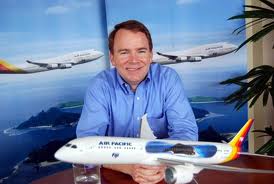
Nice looking aircraft on your desk Dave, but there are none meeting schedules in the Sky.
The flight to Sydney did not leave on Sunday, it was delayed until Monday, now it has been delayed until Tuesday morning at 3 am, is this the final delay for that flight Dave, and do you know the answer ?
No one is telling the truth about the old 747-400 stuck in the good old USA. Also given that you cancelled the domestic scheduled flights from Nausori to Nadi at 60 minutes notice it indicates that your problems are not confined to the international schedule.. In fact right now Dave not many people trust you or our airline, it is for sure the the Fiji Pensioners do not, we have been around a long time and seen enough BS Artists come and go to know one when we see one.
One last bit of advice Dave, you will never be able to fix a problem if you lie to yourself (and others) about not having one.
And for the FNPF, get our $400,000,000 back before it is lost forever.
29 Sunday Jan 2012
Posted in Articles & Reports

Fast Talking High Flying Dave will be kept very busy talking his way out of the latest Air Pacific disruptions, and the current question is “Does Dave have a devious plan to destroy our national airline”. Certainly the situation at Air Pacific with flight schedules and staff moral is now the worst it has ever been in Air Pacific history, and we the pensioners as the largest investor in Air Pacific (US$200,000,000) Nearly F$400,000,000 have a right to be concerned and demand answers from the very vocal minister responsible, who coincidently not only encouraged the investment, but introduced legislation to cabinet to reduce our pensions.
He should now be ensuring that we are not being taken for a ride down the road to Air Pacific insolvency by FTHF Dave. After nearly two years on the Flight Deck, FTHF Dave should be asked why mismanagement requires Air Pacific to indulge in two costly wet air chartered aircraft at the same time.
We still have disruptions to flight schedules, just ask travellers to and from Australia, ask the passengers booked on Mondays flight to Tonga.
FTHF Dave may be able to talk the talk, but clearly he cannot walk the walk.
This from Saturdays Sun
“Air Pacific has charted an aircraft from Atlas Air Worldwide Holdings to reduce flight disruptions in the Nadi – Los Angeles flights.
This is as Air Pacific’s Boeing 747-400 scheduled to undergo engine change faces further delays in Los Angeles.
Air Pacific spokesman Shane Hussein confirmed Air Pacific has brought in the chartered plane to help them carry their passengers from Nadi to Los Angeles and from Los Angeles to Nadi.
“To minimise disruptions and inconvenience to our guests, we chartered an Air Atlas aircraft to service our Los Angeles – Nadi and Nadi – Los Angeles flights, at the times advised yesterday,” he said.
The B747-400 Air Pacific aircraft that usually services the Los Angeles route has been undergoing an engine change, resulting in the chartering of the Atlas aircraft.
Air Pacific has also chartered an Air New Zealand plane to ease flight disruptions for the New Zealand to Nadi and Nadi to New Zealand route.
Hey Dave, what happened to Qantas, they own 46%, why is it they cannot help you?
The rest of the Sun article reads like a promotional advertisement for Atlas Air, could there be commissions at stake?

