
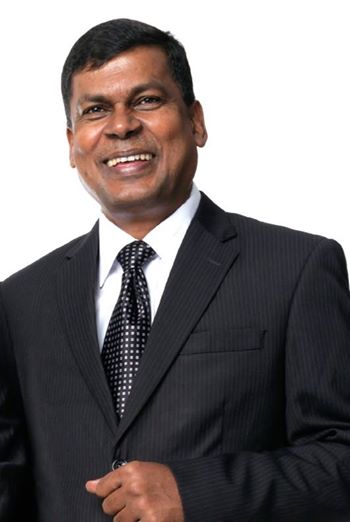
Hon. BIMAN PRASAD, WEDNESDAY, OCTOBER 15, 2014
Madam Speaker, I join honourable Members of Parliament in thanking his Excellency our President for his most gracious speech.
On behalf of the NFP; I also thank him for setting the tone of this parliament by reminding us of responsibility that Government and the Opposition share in charting the next phase of our history.
Madam Speaker, our people have spoken. They have elected their government for the next four years. We wish the Prime Minister Honourable Josaia Voreqe Bainimarama and his government well for the next four years.
Madam Speaker, I join the whole country in congratulating you on your election as our speaker. As the first woman Speaker of this House; your appointment will also serve as an inspiration to women across our country to reach for greater heights.
I also extend the NFP’s congratulations to Marama Bale Roko Tui Dreketi Honourable Ro Teimumu Kepa as the Leader of the Opposition; following on from the late Mrs Irene Jai Narayan of the National Federation Party as Deputy Opposition Leader, again a first for women in our country.
I also congratulate the Secretary-General of Parliament, Mrs Viniana Namosimalua, her Deputy, and all the Honourable women Members of Parliament.
Madam Speaker, I also again congratulate Honourable Tupou Draunidalo on her appointment as the President of the oldest political party in the South Pacific, the National Federation Party.
Madam Speaker, I extend our thanks to both the Benches in sending such a strong signal towards empowerment of women. Our country will move forward only if women and men work together honestly and equally. We are hopeful that this rare line up of talent will ensure that all government programs and laws are given detailed scrutiny for their positive impact on women and girls.
The NFP will work with you in ensuring that there is a renewed national urgency in dealing with issues that affect women especially; ranging from their serious under-represetation at top levels of the civil service; to the growing incidence of domestic violence; to the painful reality of extreme poverty in which tens of thousands of women currently live in.
After 8 painful years, parliamentary democracy has returned to Fiji. It is fitting that the restoration of parliamentary democracy coincides with a period of festivity – having just celebrated Eid; and heading to celebrate Diwali. Our men led so ably by Osea Kolinisau have already given the nation an early Christmas cheer. We have much to celebrate.
We do have much to celebrate in our return to parliamentary democracy.
Madam Speaker; to those who have had the privilege to be elected to this parliament; let me say; we have two obligations at the core of our role as MP’s. First, we have to make our democracy work; and second, we have to make our democracy work for our people.
Madam Speaker, what do I mean by that?
To make our democracy work; we need to ensure that our citizens and their organizations are able to freely comment, support and when needed criticize policies and programs being debated by this House. They need to know that our media will amplify their voices and ensure that their voices are directly heard by us. This way we will know how citizens feel about and experience government policies and programs. Our democracy will grow from this new openness.
Second, we need to make our democracy work for our people. The Honourable Prime Minister called for our support to his program for Government. We will extend that support. In extending that support, we will hold the Honourable Prime Minister to his own words.
The Honourable Prime Minister has promised a better future for our youth. We will ask that he show to this House how his programs will impact on creating jobs for our young. We will ask that he shows how his programs will contribute to increasing their incomes when in employment. Through this constructive exchange; we expect that the Government’s programs will become sharper and more impactful.
Madam Speaker, the composition of our House shows that while this House represents our return to parliamentary democracy; our democracy remains work in progress.
The fact that a vast majority of MP’s on Opposition Benches are ITaukei draws attention to the fact that institutions, laws and programs that affect ITaukei communities in specific ways need to be reviewed and consensus built around some of these issues.
As a party the NFP fought the general elections on specific issues. Team NFP had 49 men and women of integrity, honesty, and qualified to serve the people of Fiji. We did not campaign along racial and religious lines or promote lies and deceit.
We thank our members, supporters and well-wishers for placing their trust in us. We did not win any seats in the 1999 and 2006 general elections.
Madam Speaker, it is therefore a matter of some pride that the NFP is back in Parliament with 3 seats. We were here in this fine building during the Legislative Council era led by the late A D Patel in the 1960’s. Then the NFP raised the issue of the need for a pensions institution for our workers.
We were here represented by the late Siddiq Koya when we extended our support to transition to full independence.
We were here when under the leadership of now retired international jurist Jai Ram Reddy when the country made considerable progress economically and socially in the 1970s and early 1980s.
We were here when that progress was painfully derailed by the start of the debilitating cycle of coups.
We are here today to help put that last 27 years of suffering behind us; heal our nation and move on to find our greatness and our rightful place as the leader of the South Pacific.
We had, like other parties contested to form government. We have fallen short. But this takes nothing away from the heroic effort led by the greatest team of volunteers in the country – the Team NFP. A heartfelt thanks to Team NFP.
We are represented by three MPs today. Their election speaks of the resilience of the principles of fairness, equality and social justice. These principles have defined the National Federation Party inside this House and outside for all 51 years of its existence.
Madam Speaker, and Honourable Members; these are the principles that we offer to the Government to take our country forward and help it realize its full potential.
Madam Speaker,
When necessary we will criticize government’s policies. When we shall do so, it will not be for the sake of doing so, but because we in our considered view are able to provide credible alternatives.
Madam Speaker, we understand that change requires time. More than time; change requires perseverance. Growing up as a young adult in uncertain post-coup times, when my identity and religious convictions were challenged, I could in despair have packed up and left. I did not. I did not do so because I believe that we can change things for the better. This belief is at the core of my values.
I did not resign as Professor of Economics to pursue politics as a career. I joined politics with a deep conviction that through collective action and perseverance we can change things in Fiji for the better; however difficult the obstacles might be.
My upbringing has taught me the virtues of truth, righteousness. These values are highlighted especially during the Diwali festivities. But I have also grown up realizing that that the way to truth and righteousness can be a tortuous route to doing good.
Politics to me is an extension of these values – through slow and deliberate collective action on that path of truth and righteousness; we pursue and seek solutions to the great problems in our national life.
Madam Speaker, As tradition dictates, His Excellency the President outlined Government’s policies for the ensuing year.
The high cost of living, the decline of the sugar industry, the crippling effects of the drought, rising unemployment, derogations in the Bill of Rights of the 2013 Constitution, regressive and draconian decrees, a regulated media and the deteriorating health system and medical services are fundamental problems that can only be resolved through leadership; collective action and perseverance.
We have been sent to this House to solve these problems. We have very little to celebrate in our parliamentary democracy when a third of our people live in extreme poverty.
We have very little to celebrate, if poor mothers across our country have to wait for hours in government hospitals for doctors to attend to their sick children.
We have very little to celebrate for so long as a situation persists where a worker employed at the minimum wage needs to work for 5 hours to earn enough to put one decent meal for his or her family.
No one party has the monopoly of ideas for fully resolving these social and economic problems. But we all share the shame that this brings to us as a nation.
We will need perseverance, frank and open dialogue and a shared commitment on all sides to seek consensual solutions to these problems.
Madam Speaker, His Excellency the President alluded to genuine democracy and to the trust, which has been placed by the people of Fiji in the honourable members of this Parliament.
The question that arises Madam Speaker is that -Are we living and practicing genuine democracy? Have the elections and the re-opening of Parliament re-established checks and balances, and fair-play?
Madam Speaker, the continuation of regressive decrees will render meaningless all talk of Fiji once again being a genuinely democratic nation.
The Media Industry Development Authority Decree, the Essential National Industries (Employment) Decree, the Political Parties (Registration, Conduct, Funding and Disclosures) Decree must be repealed by Parliament because they curtail the rights of the media, ordinary workers, trade unionists, and ultimately our people.
More specifically, in a real democracy Madam Speaker, people must have the liberty to speak openly and candidly. In it the Government of the day listens and the media exercises its role as the messenger, a watchdog of democracy, and as an independent institution, responsibly asserting a right to speak with its own voice, and not merely echoing the voice of parliament or the executive government.
Continue reading







 Fiji Pensioners